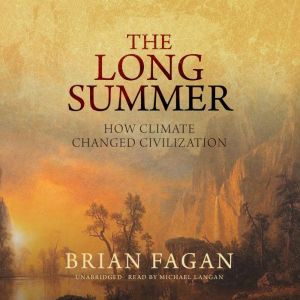
The Long Summer, Brian Fagan
1 Rating(s)
List: $19.95 | Sale: $13.97
Club: $9.97

The Long Summer
How Climate Changed Civilization

Author: Brian Fagan

Narrator: Michael Langan

Unabridged: 9 hr 36 min

Format: Digital Audiobook Download

Published: 07/09/2022


Synopsis

For more than a century we’ve known that much of human evolution occurred in an Ice Age. Starting about fifteen thousand years ago, temperatures began to rise, the glaciers receded, and sea levels rose. The rise of human civilization and all of recorded history occurred in this warm period, known as the Holocene. Until very recently we had no detailed record of climate changes during the Holocene. Now we do. In this engrossing and captivating look at the human effects of climate variability, Brian Fagan shows how climate functioned as what the historian Paul Kennedy described as one of the “deeper transformations” of history—a more important historical factor than we understand.

About Brian Fagan

Brian Fagan is the author of numerous acclaimed books on climate and archaeology. A former Guggenheim Fellow, he is professor emeritus of anthropology at the University of California, Santa Barbara.

About Michael Langan

Michael Langan works as a freelance editor, writing mentor, and teacher and also facilitates creative writing and critical reading workshops. He taught creative writing and English literature at Greenwich University, London, for ten years before giving it up to focus on his writing career. He was arts editor of the online LGBTQ arts and culture journal Polari Magazine, during which time he wrote on visual art, cinema, and books. For the past three years, he has joined forces with The Literary Consultancy (TLC), London, to offer manuscript assessments to emerging LGBTQ writers as part of TLC’s Free Reads scheme, sponsored by the Arts Council England.


Reviews

Goodreads review by Clare on July 03, 2018

I enjoyed this look at the progress of humans and then their civilisations, as affected by the climate shifts. For instance we get very visual descriptions of the Sahara (and Gobi later) as expanding with green from extra rainfall on the edges, this green being seized upon by cattle herders while it......more

Goodreads review by Carlos on September 20, 2013

A sweeping history of the post-Ice Age migrations of humans over the last 18,000 years. This is a great book, and it answers so many questions about why people ended up in the pockets of the world in which they did, as well as why and how agriculture developed where it did. The one problem I have wi......more

Goodreads review by Brett on July 15, 2020

Fagan adds a new dimension to the failure of civilizations outside value reversals and psychological self-destruction posed by Brooks Adams, Spengler, or de Tocqueville. Data from a variety of sources, not available until recently, correlates with history the impacts of climate on civilization. Faga......more

Goodreads review by Anne on May 06, 2016

We are intrinsically enmeshed with the weather. This book takes us on a trip through the history of the world through the eyes of everyman. It is an amazing journey. It compels us to live with humans starting with the Cro-Magnons of 18,000 years ago as they emerged from their caves to hunt beasts an......more

Goodreads review by Qmmayer on January 04, 2020

Perhaps two stars is ungenerous, but that's colored by my initial enthusiasm leaching away as I dragged myself through this book. Fagan states his premise early on, using a marine metaphor: humanity has moved from the nimble sailboat (small groups relying on domestic agriculture supplemented by hunt......more


Quotes

“This highly readable account of climate changes and their impact brings together a very deep knowledge of archaeology with imaginative narrative…A fascinating and provocative book.” Norman Cantor, author of Antiquity: Civilization of the Ancient World

“The Long Summer is a fascinating tale of humanity and climate, woven together seamlessly in the cloth of history.” Richard B. Alley, author of The Two-Mile Time Machine