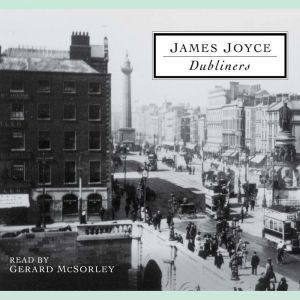
Dubliners, James Joyce
List: $7.50 | Sale: $5.25
Club: $3.75

Dubliners
A Selection of Short Stories

Author: James Joyce

Narrator: Gerald McSorley

Abridged: 2 hr 32 min

Format: Digital Audiobook Download

Publisher: Penguin Audio

Published: 09/17/2008


Synopsis

Dubliners was completed in 1905, but a series of British and Irish publishers and printers found it offensive and immoral, and it was suppressed.  The book finally came out in London in 1914, just as Joyce's Portrait of the Artist as a Young Man began to appear in the journal Egoist under the auspices of Ezra Pound.  The first three stories in Dubliners might be incidents from a draft of Portrait of the Artist, and many of the characters who figure in Ulysses have their first appearance here, but this is not a book of interest only because of its relationship to Joyce's life and mature work.  It is one of the greatest story collections in the English language--an unflinching, brilliant, often tragic portrait of early twentieth-century Dublin.  The book, which begins and ends with a death, moves from "stories of my childhood" through tales of public life.  Its larger purpose, Joyce said, was as a moral history of Ireland.

About The Author

James Joyce (1882–1941), an Irish poet and novelist, was one of the most celebrated writers of the twentieth century. His works include UlyssesFinnegans Wake, and A Portrait of the Artist as a Young Man.Colum McCann (foreword) is the author of the National Book Award–winning novel Let the Great World Spin and of TransAtlantic. Born in Dublin, Ireland, he now lives in New York City.Terence Brown (introduction and notes) is an emeritus fellow of Trinity College Dublin.Roman Muradov (cover illustrator) has done illustrations for an array of clients, including The New Yorker, The New York TimesVogue, NPR, and Dark Horse Comics. He lives in San Francisco.


Reviews

Goodreads review by Sean Barrs on October 22, 2017

Life is full of missed opportunities and hard decisions. Sometimes it’s difficult to know what to actually do. Dubliners creates an image of an ever movie city, of an ever moving exchange of people who experience the reality of life. And that’s the whole point: realism. Not everything goes well, n......more

Goodreads review by Jim on August 11, 2023

Dubliners is a collection of short stories published in 1914. The concluding story is The Dead, which the blurb on GR cites as “the best short story ever written.” We are told in a brief introduction that Joyce was a pioneer in popularizing the structure of the modern short story as focused on “a fl......more

Goodreads review by Leonard on October 04, 2021

In The Dead, the last story in this collection, Gabriel Conroy recounts an anecdote about his grandfather and his horse, Johnny, who used to walk in circles to drive the grinding stone in a mill. One day, the grandfather harnessed the horse and took him out to a military review. But Johnny, disorien......more

Goodreads review by Vit on August 11, 2023

Childhood… Old age… Ages in between… Coming of age… Dying… “Oh, quite peacefully, ma’am, said Eliza. You couldn’t tell when the breath went out of him. He had a beautiful death, God be praised.” The first amorous admiration from afar… I thought little of the future. I did not know whether I would ever......more


Quotes

“In Dubliners, Joyce’s first attempt to register in language and fictive form the protean complexities of the ‘reality of experience,’ he learns the paradoxical lesson that only through the most rigorous economy, only by concentrating on the minutest of particulars, can he have any hope of engaging with the immensity of the world.”–from the Introduction

“Joyce renews our apprehension of reality, strengthens our sympathy with our fellow creatures, and leaves us in awe before the mystery of created things.” –Atlantic Monthly

“It is in the prose of Dubliners that we first hear the authentic rhythms of Joyce the poet…Dubliners is, in a very real sense, the foundation of Joyce’s art. In shaping its stories, he developed that mastery of naturalistic detail and symbolic design which is the hallmark of his mature fiction.” –Robert Scholes and A. Walton Litz, authors of Dubliners: Text and Criticism

With an Introduction by John Kelly