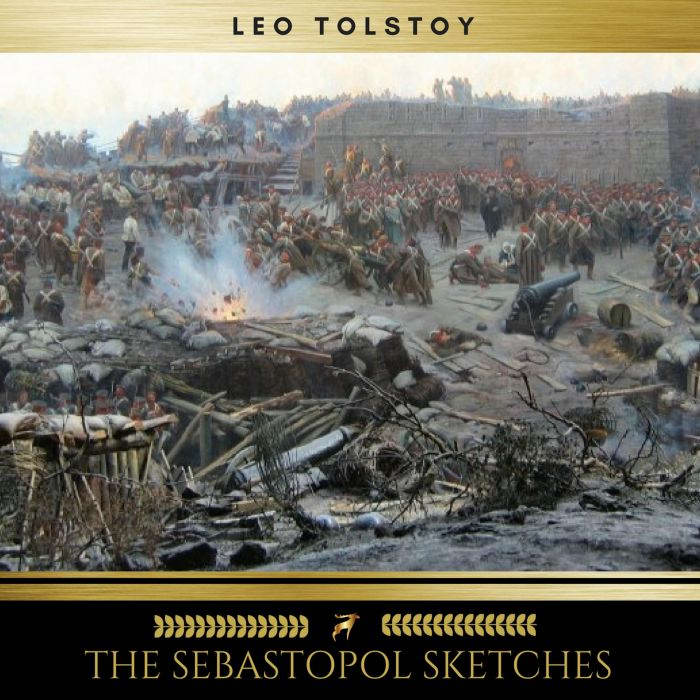
The Sebastopol Sketches, Leo Tolstoy
List: $1.99 | Sale: $1.40
Club: $0.99

The Sebastopol Sketches

Author: Leo Tolstoy

Narrator: Sean Murphy

Unabridged: 4 hr 50 min

Format: Digital Audiobook Download

Published: 09/05/2018

Categories: Fiction, Anthologies, Classic


Synopsis

In the winter of 1854 Tolstoy, then an officer in the Russian army, arranged to be transferred to the besieged town of Sebastopol. Wishing to see at first hand the action of what would become known as the Crimean War, he was spurred on by a fierce patriotism, but also by an equally fierce desire to alert the authorities to appalling conditions in the army. The three "Sebastopol Sketches" - December', May' and August' - re-create what happened during different phases of the siege and its effect on the ordinary men around him. Writing with the truth as his utmost aim, he brought home to Russia's entire literate public the atrocities of war. In doing so, he realized his own vocation as a writer and established his literary reputation.

About Leo Tolstoy

Leo Tolstoy was born in 1828 at Yasnaya Polyana in central Russia and educated privately. He studied Oriental languages and law at the University of Kazan, then led a life of dissipation until 1851, when he went to the Caucasus and joined an artillery regiment. He took part in the Crimean War, and on the basis of this experience wrote The Sevastopol Stories, which confirmed his tenuous reputation as a writer.

After a period in St. Petersburg and abroad, where he studied educational methods for use in his school for peasant children at Yasnaya Polyana, Tolstoy married Sofya Behrs in 1862. The next fifteen years was a period of great happiness: the couple had thirteen children, and Tolstoy managed his estates, continued his educational projects, and wrote War and Peace and Anna Karenina.

A Confession marked a spiritual crisis in Tolstoy's life; he became an extreme moralist, and in a series of pamphlets written after 1880, he expressed his rejection of state and church, indictment of the weaknesses of the flesh, and denunciation of private property. He published his last novel, Resurrection, in 1900.

Tolstoy's teaching earned him many followers at home and abroad, but also much opposition, and in 1901 he was excommunicated by the Russian Orthodox Church. He died in 1910.


Reviews

There are currently no user reviews for this audiobook.