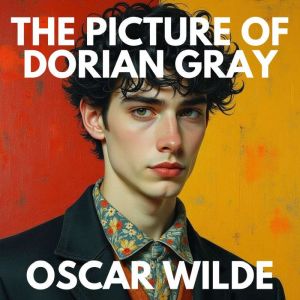
The Picture of Dorian Gray, Oscar Wilde
List: $9.95 | Sale: $6.96
Club: $4.97

The Picture of Dorian Gray
A Gothic Psychological Classic

Author: Oscar Wilde

Narrator: Roland Wisely

Unabridged: 8 hr 36 min

Format: Digital Audiobook Download

Published: 09/30/2024


Synopsis

Dorian Gray is young, wealthy, and extraordinarily handsome. When his portrait is painted, he makes a fateful wish—that the image will bear the marks of age and corruption while he himself remains forever young. The wish is granted, and as Dorian plunges deeper into a life of excess and moral compromise, the portrait begins to change in ways both disturbing and profound.While Dorian’s outward appearance remains untouched by time, the hidden image records every sin, every cruelty, and every secret. Trapped between pleasure and conscience, he is drawn into a psychological struggle that questions the true cost of beauty, vanity, and unchecked desire.First published in 1890, The Picture of Dorian Gray is Oscar Wilde’s haunting masterpiece—a gothic and philosophical novel that explores identity, morality, and the danger of living without restraint. Elegant, unsettling, and timeless, it remains one of the most influential works of classic literature.Perfect for fans of gothic fiction, literary classics, and psychological drama, this audiobook invites you to listen closely—and look beneath the surface.

About Oscar Wilde

Oscar Wilde was born in Dublin on October 16, 1854. He excelled at Trinity College in Dublin from 1871 to 1874, eventually winning a scholarship to Magdalene College in Oxford, which he entered in 1875. The biggest influences on his development as an artist at this time were Swinburne, Walter Pater, and John Ruskin.

In 1875, Wilde began publishing poetry in literary magazines. In 1876 he found himself back in Ireland when the death of his father left the family with several debts. Wilde continued writing poetry in earnest, and in 1878, he won the coveted Newdigate Prize for English poetry. He soon left Oxford to build himself a reputation among the literati in London.

During the 1880s, Wilde established himself as a writer, poet, and lecturer, but above all as a "professor of aesthetics." In 1884, he married Constance Lloyd in London. Sons soon followed: Cyril in 1885 and Vyvyan in 1886. During these years, Wilde worked as a journalist and reviewer, while also continuing with his other writing of poetry and plays. In 1890 he published his well-known story The Picture of Dorian Gray. The early 1890s were the most intellectually productive and fruitful time for Wilde. Some of his most familiar plays-including Lady Windemere's Fan and Salome-were written and performed upon the London stages. In 1893 Wilde produced A Woman of No Importance and An Ideal Husband, followed in 1894 by The Importance of Being Earnest.

Wilde's life took a turn for the worst when, in May 1895, he was convicted of engaging in homosexual acts, which were then illegal, and sentenced to two years imprisonment with hard labor. He soon declared bankruptcy, and his property was auctioned off. In 1896, Wilde lost legal custody of his children. When his mother died that same year, his wife Constance visited him at the jail to bring him the news. It was the last time they saw each other. In the years after his release, Wilde's health deteriorated. In November 1900, he died in Paris at the age of forty-six.


Reviews

Goodreads review by Scoobs on July 21, 2008

Oh Dorian. Oh Dorian. When I first read this book in the fruitless years of my youth I was excited, overwhelmed and a blank slate (as Dorian is, upon his first encounter with Lord Henry) easily molded, persuaded, influenced, etc. Certain Wildisms (Wildeisms?) would take my breath away. Would become my......more

Goodreads review by Sean Barrs on March 13, 2022

I finished reading this last night, and afterwards I spent an entire hour staring into space so I could contemplate over the majesty of this work. It left me speechless. This book is exquisite; it is an investigation into the human soul, the power of vanity and the problems of living a life with not......more

Goodreads review by Emily May on January 26, 2019

"The sitter is merely the accident, the occasion. It is not he who is revealed by the painter; it is rather the painter who, on the coloured canvas, reveals himself. The reason I will not exhibit this picture is that I am afraid that I have shown in it the secret of my own soul." And so b......more

Goodreads review by Paula on December 04, 2013

This book reminded me why I hate classics. Like Frankenstein, it starts out with a great premise: what if a portrait bore the brunt of age and sin, while the person remained in the flush of youth? How would that person feel as they watched a constant reminder of their true nature develop? And like Fr......more

Goodreads review by Ruby on March 15, 2021

2021 - I re-read this for university and loved it even more the second time round... Lord Henry is a paradigmatic sophist and his epigrams are delightful (partly because it's easy to forget that he is more rhetoric than truth). The connection between youthful appearance and character is also so fasc......more