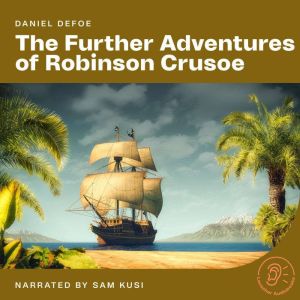
The Further Adventures of Robinson Cr..., Daniel Defoe
List: $15.49 | Sale: $10.85
Club: $7.74

The Further Adventures of Robinson Crusoe

Author: Daniel Defoe

Narrator: Sam Kusi

Unabridged: 9 hr 46 min

Format: Digital Audiobook Download

Published: 03/08/2024

Categories: Fiction, Classic


Synopsis

"The Further Adventures of Robinson Crusoe" is a novel by Daniel Defoe, first published in 1719. Just as in its significantly more popular predecessor, Robinson Crusoe (1719), the first edition credits the work's fictional protagonist Robinson Crusoe as its author. It was published under the considerably longer original title: The Farther Adventures of Robinson Crusoe; Being the Second and Last Part of His Life, And of the Strange Surprising Accounts of his Travels Round three Parts of the Globe. Although intended to be the last Crusoe tale, the novel is followed by a non-fiction book involving Crusoe by Defoe entitled Serious Reflections During the Life and Surprising Adventures of Robinson Crusoe: With his Vision of the Angelick World (1720). The story is speculated to be partially based on Moscow embassy secretary Adam Brand's journal detailing the embassy's journey from Moscow to Peking from 1693 to 1695. The book starts with the statement about Crusoe's marriage in England. He bought a little farm in Bedford and had three children: two sons and one daughter. Our hero suffered a distemper and a desire to see "his island." He could talk of nothing else, and one can imagine that no one took his stories seriously, except his wife. She told him, in tears, "I will go with you, but I won't leave you." But in the middle of this felicity, Providence unhinged him at once, with the loss of his wife.

About Daniel Defoe

Daniel Defoe (1660–1731) is an English novelist, pamphleteer, and journalist, whose most famous work is Robinson Crusoe. Along with Samuel Richardson, Defoe is considered the founder of the English novel.

Defoe studied at Charles Morton's Academy in London, then delved into politics and trade, for which he traveled extensively throughout Europe. In the early 1680s, Defoe was a commission merchant in Cornhill but went bankrupt in 1691. In 1684 he married Mary Tuffley, with whom he had two sons and five daughters.

In 1702 Defoe wrote his famous pamphlet The Shortest Way With Dissenters, in which he mimicked the extreme attitudes of High Anglican Tories and pretended to argue for the extermination of all Dissenters. Defoe was arrested and pilloried for it.

When the Tories fell from power Defoe continued to carry out intelligence work for the Whig government. In his own days, Defoe was regarded as an unscrupulous, diabolical journalist.

Defoe was one of the first to write stories about believable characters in realistic situations using simple prose. He achieved literary immortality when in 1719 he published Robinson Crusoe, which was based partly on the memoirs of voyagers and castaways, such as Alexander Selkirk. During his remaining years, Defoe concentrated on books rather than pamphlets. Among his works are Moll Flanders, A Journal of the Plague Year, and Captain Jack. His last great work of fiction, Roxana, appeared in 1724. By the 1720s Defoe had ceased to be politically controversial in his writings, and he produced several historical works, a guide book, and The Great Law of Subordination Considered, an examination of the treatment of servants.

Phenomenally industrious, Defoe produced in his last years works involving the supernatural: The Political History of the Devil and An Essay on the History and Reality of Apparitions. He died on April 26, 1731, at his lodgings in Ropemaker's Alley, Moorfields.


Reviews

There are currently no user reviews for this audiobook.