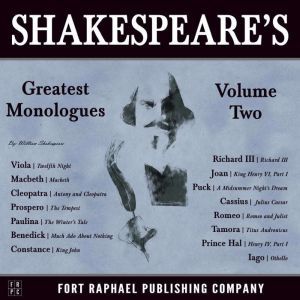
Shakespeare's Greatest Monologues
Volume II
Author: William Shakespeare
Narrator: Erin Philpott, David Blixt, Elizabeth Laidlaw, Ronald Keaton, Karen Woditsch, Mark Richard, Angela Iannone, Barbara Zahora, Christopher Prentice, Tom Mula, Rob McLean, Mickey Theis, Laura Spaeth, Austyn Williamson and John Lister
Unabridged: 53 min
Format: Digital Audiobook Download
Publisher: SoundCraft Audiobooks
Published: 11/14/2021
Categories: Fiction, Drama, Nonfiction, Literary Collections, Performing Arts, Monologues & Scenes
Synopsis
These skills are perhaps best encapsulated in the monologues he gives his various protagonists, villains and bit players. From the ambitious Scottish general Macbeth contemplating the assassination of his sovereign king to the saintly Joan of Arc from "Henry VI" inspiring soldiers to follow her into battle, to Richard III's evil and traitorous plotting, to the mischievous sprite Puck from "A Midsummer Night's Dream" celebrating his bewitching of the Fairy Queen, Shakespeare's monologues are short distillations of his larger themes - love and loss, fairness and inequity, power and envy, lust and purity.
Fort Raphael Publishing is proud to present, in this first volume, some of Shakespeare's greatest monologues, each of which captures a shining, brilliant moment from his plays that gives us a deeper understanding of each character, whether flattering, damning or inspiring.Enjoy this collection of monologues from the greatest theatrical writer in the English language - William Shakespeare.