List: $32.99
| Sale: $23.10
Club: $16.49
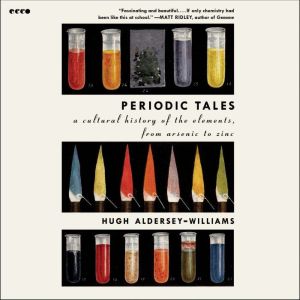
Periodic Tales
A Cultural History of the Elements, from Arsenic to Zinc
Author: Hugh Aldersey-Williams
Narrator: John Sackville
Unabridged: 13 hr 36 min
Format: Digital Audiobook Download
Publisher: Ecco
Published: 10/07/2025
Categories: Nonfiction, Science, Chemistry, History, Social History, Earth Sciences
Synopsis
A prize-winning science writer reveals the intricate ways that the elements are woven into our culture, history, and language in stories of discovery and discoverers; of rituals and values; of exploitation and celebration; and of superstition as well as scienceLike the alphabet, the calendar or the zodiac, the Periodic Table classifying the chemical elements—the fundamental ingredients of all matter—offers a system of order in our world. But while most of us learned the basics about these building blocks, many of the elements themselves remain a mystery. What does xenon look like? How does iodine exist in nature? How did krypton get its name? What is bromine used for?Periodic Tales is a passionate and compelling journey that takes us into the past and back to the future, into mines and artists’ studios, factories and cathedrals, forests and the seas to discover the true stories about the elements that make up our universe. Combining history, biography mythology, chemistry, politics, geography, geology, astronomy, and religion, Hugh Aldersey-Williams reveals how the Roman Empire was built on bronze, the Spanish on gold, the British on iron and coal. He explains why we regard lead as grave, tin as cheap, and silver as virginal. And he shows their very nomenclature speaks of history. Elements discovered during the Enlightenment (titanium, niobium, palladium, uranium) have names derived from Classical mythology, while those found during the 19th century honored the nations from which their discovers hailed (germanium, scandium, polonium, europium, franconium).Listeners can have no better guide than Aldersey-Williams. An exploration and paean to the wonder of our world Periodic Tales is a rich compendium of stories of discovery and of discoverers; stories of rituals and values; stories of exploitation and celebration; stories of superstition and science.


