1 Rating(s)
List: $24.98
| Sale: $17.49
Club: $12.49
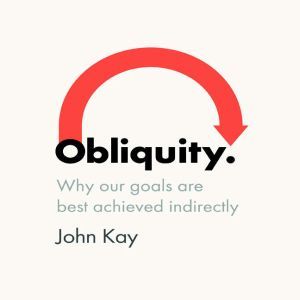
Obliquity
Why Our Goals Are Best Achieved Indirectly
Author: John Kay
Narrator: Erik Synnestvedt
Unabridged: 4 hr 49 min
Format: Digital Audiobook Download
Publisher: Ascent Audio
Published: 06/13/2011
Categories: Nonfiction, Self-help, Personal Growth
Synopsis
A leading economist charts the indirect road to happiness and wealth.
Using dozens of practical examples from the worlds of business, politics, science, sports, literature, even parenting, esteemed economist John Kay proves a notion that feels at once paradoxical and deeply commonsensical: The best way to achieve any complex or broadly defined goal-from happiness to wealth to profit to preventing forest fires-is the indirect way. As Kay points out, we rarely know enough about the intricacies of important problems to tackle them head-on. And our unpredictable interactions with other people and the world at large mean that the path to our goals-and sometimes the goals themselves-will inevitably change. We can learn about our objectives and how to achieve them only through a gradual process of risk taking and discovery-what Kay calls obliquity.
Kay traces this pathway to satisfaction as it manifests itself in nearly every aspect of life. The wealthiest people-from Andrew Carnegie to Bill Gates-achieved their riches through a passion for their work, not because they set materialistic goals. Research has shown that companies whose goal (as declared in mission statements) is excellent products or service are more profitable than companies whose stated goal is increasing profits. In the personal realm, a large body of evidence shows that parenthood is on a daily basis far more frustrating than happy- making. Yet parents are statistically happier than nonparents. Though their short-term pleasure is often thwarted by the demands of childrearing, the subtle-oblique-rewards of parenthood ultimately make them happier.
Once he establishes the ubiquity of obliquity, Kay offers a wealth of practical guidance for avoiding the traps laid by the direct approach to complex problems. Directness blinds us to new information that contradicts our presumptions, fools us into confusing logic with truth, cuts us off from our intuition (which is the subconscious expression of our experience), shunts us away from alternative solutions that may be better than the one we're set on, and more. Kay also shows us how to acknowledge our limitations, redefine our goals to fit our skills, open our minds to new data and solutions, and otherwise live life with obliquity.
This bracing manifesto will convince listeners-or confirm their conviction-that the best route to satisfaction and success does not run through the bottom line.
Using dozens of practical examples from the worlds of business, politics, science, sports, literature, even parenting, esteemed economist John Kay proves a notion that feels at once paradoxical and deeply commonsensical: The best way to achieve any complex or broadly defined goal-from happiness to wealth to profit to preventing forest fires-is the indirect way. As Kay points out, we rarely know enough about the intricacies of important problems to tackle them head-on. And our unpredictable interactions with other people and the world at large mean that the path to our goals-and sometimes the goals themselves-will inevitably change. We can learn about our objectives and how to achieve them only through a gradual process of risk taking and discovery-what Kay calls obliquity.
Kay traces this pathway to satisfaction as it manifests itself in nearly every aspect of life. The wealthiest people-from Andrew Carnegie to Bill Gates-achieved their riches through a passion for their work, not because they set materialistic goals. Research has shown that companies whose goal (as declared in mission statements) is excellent products or service are more profitable than companies whose stated goal is increasing profits. In the personal realm, a large body of evidence shows that parenthood is on a daily basis far more frustrating than happy- making. Yet parents are statistically happier than nonparents. Though their short-term pleasure is often thwarted by the demands of childrearing, the subtle-oblique-rewards of parenthood ultimately make them happier.
Once he establishes the ubiquity of obliquity, Kay offers a wealth of practical guidance for avoiding the traps laid by the direct approach to complex problems. Directness blinds us to new information that contradicts our presumptions, fools us into confusing logic with truth, cuts us off from our intuition (which is the subconscious expression of our experience), shunts us away from alternative solutions that may be better than the one we're set on, and more. Kay also shows us how to acknowledge our limitations, redefine our goals to fit our skills, open our minds to new data and solutions, and otherwise live life with obliquity.
This bracing manifesto will convince listeners-or confirm their conviction-that the best route to satisfaction and success does not run through the bottom line.


