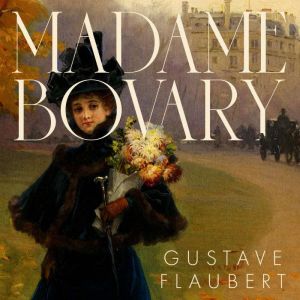
Madame Bovary, Gustave Flaubert
List: $33.49 | Sale: $23.45
Club: $16.74

Madame Bovary

Author: Gustave Flaubert

Narrator: Georgina Sutton

Unabridged: 11 hr 56 min

Format: Digital Audiobook Download

Publisher: SNR Audio

Published: 12/03/2025

Categories: Fiction, Classic


Synopsis

'Love, she thought, must come suddenly, with great outbursts and lightnings – a hurricane of the skies, which falls upon life, revolutionizes it, roots up the will like a leaf, and sweeps the whole heart into the abyss.' A powerful critique of romantic idealism, Madame Bovary is Flaubert's most famous work. Although controversial at the time of publication due to its 'obscenity', the novel became a bestseller, and is considered a masterpiece to this day. First serialised in 1856, the novel follows the narrative of Emma Bovary, a beautiful yet naïve young woman living in rural France. Her husband, a kind-hearted physician, is committed to his wife, but Emma soon grows listless and dissatisfied with the provincial life he has provided her with. Yearning for passion, excitement and luxury, Emma daringly engages in various affairs, while accumulating enormous debt as she attempts to live a life beyond her means. A moving and tragic tale of misguided idealism, materialism and the bourgeois lifestyle – conveyed through Flaubert's heartbreakingly detached prose – Madame Bovary is an exemplary example of classic realism. This audiobook edition is brilliantly read by Georginia Sutton. Gustave Flaubert (1821 – 1880) was a French novelist, famed for being a leading proponent of literary realism. He is renowned for his debut novel, Madame Bovary, and his meticulous approach to writing. Flaubert influenced many key writers in the twentieth century, such as James Joyce and Marcel Proust, and is still widely read today.

About Gustave Flaubert

Gustave Flaubert was a French novelist of the realist school, best known for writing Madame Bovary, a story of adultery and the unhappy love affair of provincial wife Emma Bovary. As a writer, Flaubert was a perfectionist, who did not make a distinction between a beautiful or ugly subject: all was in the style.

Flaubert was born in Rouen into a family of doctors in 1821. This bourgeois background Flaubert found burdensome. He rebelled against it and was subsequently expelled from school, so he completed his education privately in Paris. Flaubert started to write during his school years. In the 1840s, Flaubert studied law at Paris, a brief episode in his life, and in 1844 he had a nervous attack. The diagnosis changed Flaubert's life. He failed his law exams and decided to devote himself to literature. In this he was helped by his father who bought him a house at Croisset, on the River Seine between Paris and Rouen.

In 1846 Flaubert met the writer Louise Colet. They corresponded regularly and she became Flaubert's mistress although they met infrequently. Colet gave her account of their relationship in Lui. After the death of both his father and his married sister, Flaubert moved at Croisset, the family's country home near Rouen.
Flaubert's relationship with Colet ended in 1855. From November 1849 to April 1851 he travelled with the writer Maxime du Camp in North Africa, Syria, Turkey, Greece, and Italy. On his return, Flaubert started Madame Bovary, which took five years to complete. It appeared first in the Revue de Paris and in book form the next year. The realistic depiction of adultery was condemned as offensive to morality and religion. Flaubert was prosecuted, though he escaped conviction.

In the 1870s, Flaubert's work gained acclaim by the new school of naturalistic writers. His narrative approach, that the novelist should not judge, teach, or explain but remain neutral, was widely adopted. Among Flaubert's later major works is Salammbo, a story of the siege of Carthage by mercenaries; Trois Contes, a collection of three tales; L'Education Sentimentale, a panorama of France set in the era of the Revolution of 1848 depicting the relationship between a young man and an older married woman; and La Tentation de Saint Antoine, which was based on the story of the fourth-century Christian anchorite who lived in the Egyptian desert and experienced philosophical and physical temptations.

Flaubert spent his last years in relative poverty and was called ''hermit of Croisset.'' He died of a cerebral hemorrhage on May 8, 1880.


Reviews

There are currently no user reviews for this audiobook.