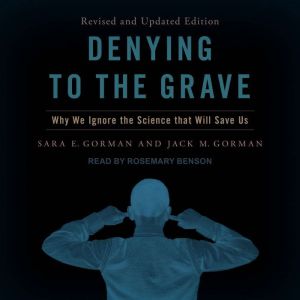
Denying to the Grave, Jack M. Gorman
List: $24.99 | Sale: $17.50
Club: $12.49

Denying to the Grave
Why We Ignore the Science That Will Save Us

Author: Jack M. Gorman, Sara E. Gorman

Narrator: Rosemary Benson

Unabridged: 17 hr 20 min

Format: Digital Audiobook Download

Publisher: Tantor Media

Published: 02/22/2022


Synopsis

In Denying to the Grave, Sara Gorman and Jack Gorman explore the psychology of health science denial. Using several examples as case studies, they propose six key principles that may lead people to reject "accepted" health-related wisdom: the charismatic leader; fear of complexity; confirmation bias; fear of corporate and government conspiracies; causality and filling the ignorance gap; and the nature of risk prediction. This fully updated new edition of Denying to the Grave reviews the most recent research on health science denial, offering a new chapter on how the contemporary "assault on science" waged by certain political administrations has eroded public trust in national health and science agencies. Also new to this edition is a chapter investigating the relationship between health crises and misinformation, and what happens to science denial amidst a global public health crisis. Finally, the book proposes a novel approach to counteracting misinformation and improving our ability to understand and accept scientific consensus.

In an era in which trust in science has become more important, and yet more elusive, Denying to the Grave sheds light on why we often choose to ignore scientific evidence, pointing the way toward a new understanding of how science should be conveyed to the public in order to save lives with existing knowledge and technology.

About Jack M. Gorman

Jack M. Gorman served on the faculty of Columbia University's Department of Psychiatry for over twenty-five years, eventually serving as Lieber Professor of Psychiatry. He then became the Esther and Joseph Klingenstein Professor and Chair of Psychiatry and Professor of Neuroscience at the Mount Sinai School of Medicine. He is currently CEO and Chief Scientific Officer, Franklin Behavioral Health Consultants. He is also the cofounder and president of Critica, a non-profit organization dedicated to improving public acceptance of science, counteracting misinformation about science and health, and increasing the use of scientific evidence in public policymaking.


Reviews

Goodreads review by Shaun on April 16, 2017

This is a book that explores why people ignore science. The conclusion can be summed up in four words, because we are human. The book and its authors also attempt to offer solutions for getting people to listen to science, a task that seems like it should be relatively simple, but that really isn't.......more

Goodreads review by Jessica on May 12, 2016

Denying to the Grave is a book on a very interesting concept: why do people believe things even when there is a wealth of scientific evidence to the contrary? The book talks about a lot of general principles, but repeatedly turns to a few specific cases to demonstrate these principles in action. The......more

Goodreads review by Matt on July 01, 2022

It all boils down to humans are emotional, social, random animals, not rational, reasonable predictable models. I'm giving this two stars not because I disagree with anything they had to say, I just found it a bit dull. I wanted some new insight and thought from it but I'm left in exactly the same p......more

Goodreads review by Mark on June 10, 2016

Cognitive decision-making processes that worked reasonably well for humans in a less complex environment are now obstacles in processing highly complicated and, often, ambiguous issues. Denying to the Grave explores the many neurological, social, and psychological reasons why every one of us can acce......more

Goodreads review by Hector on December 06, 2019

Human nature, so complicated! Sara Gorman evidences it, but she also insists on the rational behavior value (whatever this implies), no matter how hard it was. In this case, in epidemiological environments and other controversial topics related to health. However, it allows me collaterally, to underst......more