List: $10.13
| Sale: $7.10
Club: $5.06
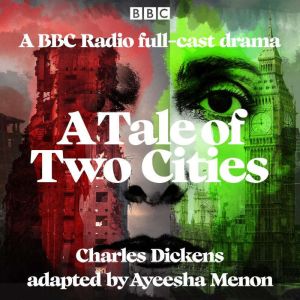
A Tale of Two Cities
A BBC Radio full-cast drama
Author: Charles Dickens
Narrator: Khalid Abdalla, Full Cast, Lara Sawalha, Fatima Adoum, Phil Davis
Unabridged: 2 hr 49 min
Format: Digital Audiobook Download
Publisher: BBC Digital Audio
Published: 10/21/2021
Categories: Fiction, Romance, Military Fiction, Adaptations
Synopsis
Ayeesha Menon's reworking of Charles Dickens' iconic story of love, revolution and redemption, updated to modern-day London and war-torn Syria
2011, Syria. The Arab Spring is underway, and after a wave of peaceful protests, President Assad agrees to a release of political prisoners. Freed after 30 years, Dr Mahmoud is taken in by Taghreed and Emad Daffar, and brought to England by his old friend Jarvis Lorry and the daughter he has never met, foreign correspondent Lina. But his years of suffering have left him a broken man.
Back in London, Jarvis convinces his nephew Sid Carton, a feckless but brilliant barrister, to defend a young Syrian émigré doctor, Shwan Dahkurdi, against charges of supporting terrorism. Lina and Shwan fall in love, only for his dark family secret to tear them apart... Meanwhile, convinced that only Lina gives his life meaning, Sid confesses his unrequited love, promising to do anything for her and those she loves.
As the city of Aleppo turns into a battleground, Taghreed becomes increasingly involved with the rebels of the Free Syrian Army. Her desire for justice - and her obsessive thirst for vengeance - will have devastating repercussions...
A powerful portrayal of personal sacrifice set against the turbulent backdrop of political change, Dickens' classic novel is as resonant today as when it was written. The redemption of flawed humanity is at the heart of award-winning writer Ayeesha Menon's riveting reimagining, spanning five years and with a seamlessly shifting perspective between Aleppo and London. Provocative, powerful and moving, this drama won a BBC Drama Audio Award for Best Adaptation, and stars Fatima Adoum, Lara Sawalha, Phil Davis, Khalid Abdalla, Shaun Parkes and Nadim Sawalha.
Production credits
A Tale of Two Cities by Charles Dickens, adapted for radio by Ayeesha Menon
Development concept written by Silas Parry
Produced by Gill Parry
Directed by Polly Thomas
Producer for Goldhawk Productions: Emma Hearn
Executive Producer: John Dryden
Broadcast Assistant: Jan Shepherd
Sound design by Eloise Whitmore
A Goldhawk Production for BBC Radio 4
Cast
Taghreed - Fatima Adoum
Lina - Lara Sawalha
Jarvis - Phil Davis
Shwan Dahkurdi - Khalid Abdalla
Sid - Shaun Parkes
Dr Mahmoud - Nadim Sawalha
Cameraman/Jerry/Driver - Shiv Grewal
Emad - Raad Rawi
Yakub/General- George Georgiou
Samia - Nathalie Armin
Syrian Protestor - Ahmed Aziz
Fadi/Guard/Local Doctor - Ammar Haj Ahmad
Secretary - Jan Shepard
First broadcast BBC Radio 4, 20 May-3 June 2018
©2021 BBC Studios Distribution Ltd (P)2021 BBC Studios Distribution Ltd
2011, Syria. The Arab Spring is underway, and after a wave of peaceful protests, President Assad agrees to a release of political prisoners. Freed after 30 years, Dr Mahmoud is taken in by Taghreed and Emad Daffar, and brought to England by his old friend Jarvis Lorry and the daughter he has never met, foreign correspondent Lina. But his years of suffering have left him a broken man.
Back in London, Jarvis convinces his nephew Sid Carton, a feckless but brilliant barrister, to defend a young Syrian émigré doctor, Shwan Dahkurdi, against charges of supporting terrorism. Lina and Shwan fall in love, only for his dark family secret to tear them apart... Meanwhile, convinced that only Lina gives his life meaning, Sid confesses his unrequited love, promising to do anything for her and those she loves.
As the city of Aleppo turns into a battleground, Taghreed becomes increasingly involved with the rebels of the Free Syrian Army. Her desire for justice - and her obsessive thirst for vengeance - will have devastating repercussions...
A powerful portrayal of personal sacrifice set against the turbulent backdrop of political change, Dickens' classic novel is as resonant today as when it was written. The redemption of flawed humanity is at the heart of award-winning writer Ayeesha Menon's riveting reimagining, spanning five years and with a seamlessly shifting perspective between Aleppo and London. Provocative, powerful and moving, this drama won a BBC Drama Audio Award for Best Adaptation, and stars Fatima Adoum, Lara Sawalha, Phil Davis, Khalid Abdalla, Shaun Parkes and Nadim Sawalha.
Production credits
A Tale of Two Cities by Charles Dickens, adapted for radio by Ayeesha Menon
Development concept written by Silas Parry
Produced by Gill Parry
Directed by Polly Thomas
Producer for Goldhawk Productions: Emma Hearn
Executive Producer: John Dryden
Broadcast Assistant: Jan Shepherd
Sound design by Eloise Whitmore
A Goldhawk Production for BBC Radio 4
Cast
Taghreed - Fatima Adoum
Lina - Lara Sawalha
Jarvis - Phil Davis
Shwan Dahkurdi - Khalid Abdalla
Sid - Shaun Parkes
Dr Mahmoud - Nadim Sawalha
Cameraman/Jerry/Driver - Shiv Grewal
Emad - Raad Rawi
Yakub/General- George Georgiou
Samia - Nathalie Armin
Syrian Protestor - Ahmed Aziz
Fadi/Guard/Local Doctor - Ammar Haj Ahmad
Secretary - Jan Shepard
First broadcast BBC Radio 4, 20 May-3 June 2018
©2021 BBC Studios Distribution Ltd (P)2021 BBC Studios Distribution Ltd


