List: $18.49
| Sale: $12.95
Club: $9.24
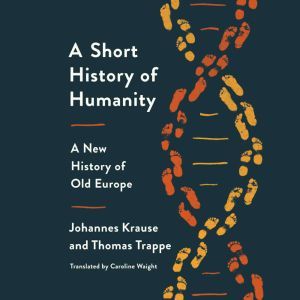
A Short History of Humanity
A New History of Old Europe
Author: Johannes Krause, Thomas Trappe, Caroline Waight
Narrator: Stephen Graybill
Unabridged: 6 hr 9 min
Format: Digital Audiobook Download
Publisher: Random House Audio
Published: 04/13/2021
Categories: Nonfiction, Social Science, Anthropology, Archaeology, History, World History
Synopsis
“Thrilling . . . a bracing summary of what we have learned [from] ‘archaeogenetics’—the study of ancient DNA . . . Krause and Trappe capture the excitement of this young field.”—Kyle Harper, The Wall Street Journal
Johannes Krause is the director of the Max Planck Institute for Evolutionary Anthropology and a brilliant pioneer in the field of archaeogenetics—archaeology augmented by DNA sequencing technology—which has allowed scientists to reconstruct human history reaching back hundreds of thousands of years before recorded time.
In this surprising account, Krause and journalist Thomas Trappe rewrite a fascinating chapter of this history, the peopling of Europe, that takes us from the Neanderthals and Denisovans to the present. We know now that a wave of farmers from Anatolia migrated into Europe 8,000 years ago, essentially displacing the dark-skinned, blue-eyed hunter-gatherers who preceded them. This Anatolian farmer DNA is one of the core genetic components of people with contemporary European ancestry. Archaeogenetics has also revealed that indigenous North and South Americans, though long thought to have been East Asian, also share DNA with contemporary Europeans.
Krause and Trappe vividly introduce us to the prehistoric cultures of the ancient Europeans: the Aurignacians, innovative artisans who carved flutes and animal and human forms from bird bones more than 40,000 years ago; the Varna, who buried their loved ones with gold long before the Pharaohs of Egypt; and the Gravettians, big-game hunters who were Europe’s most successful early settlers until they perished in the ice age.
Genetics has earned a reputation for smuggling racist ideologies into science, but cutting-edge science makes nonsense of eugenics and “pure” bloodlines. Immigration and genetic exchanges have always defined our species; who we are is a question of culture, not biological inheritance. This revelatory book offers us an entirely new way to understand ourselves, both past and present.
Johannes Krause is the director of the Max Planck Institute for Evolutionary Anthropology and a brilliant pioneer in the field of archaeogenetics—archaeology augmented by DNA sequencing technology—which has allowed scientists to reconstruct human history reaching back hundreds of thousands of years before recorded time.
In this surprising account, Krause and journalist Thomas Trappe rewrite a fascinating chapter of this history, the peopling of Europe, that takes us from the Neanderthals and Denisovans to the present. We know now that a wave of farmers from Anatolia migrated into Europe 8,000 years ago, essentially displacing the dark-skinned, blue-eyed hunter-gatherers who preceded them. This Anatolian farmer DNA is one of the core genetic components of people with contemporary European ancestry. Archaeogenetics has also revealed that indigenous North and South Americans, though long thought to have been East Asian, also share DNA with contemporary Europeans.
Krause and Trappe vividly introduce us to the prehistoric cultures of the ancient Europeans: the Aurignacians, innovative artisans who carved flutes and animal and human forms from bird bones more than 40,000 years ago; the Varna, who buried their loved ones with gold long before the Pharaohs of Egypt; and the Gravettians, big-game hunters who were Europe’s most successful early settlers until they perished in the ice age.
Genetics has earned a reputation for smuggling racist ideologies into science, but cutting-edge science makes nonsense of eugenics and “pure” bloodlines. Immigration and genetic exchanges have always defined our species; who we are is a question of culture, not biological inheritance. This revelatory book offers us an entirely new way to understand ourselves, both past and present.


