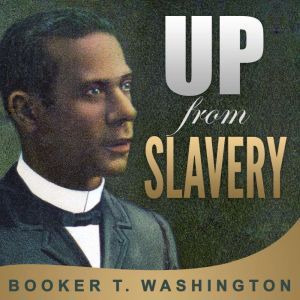
Up from Slavery
Author: Booker T. Washington
Narrator: Kevin Thies
Unabridged: 7 hr 26 min
Format: Digital Audiobook Download
Publisher: Evans Way Publishing
Published: 06/21/2020

Author: Booker T. Washington
Narrator: Kevin Thies
Unabridged: 7 hr 26 min
Format: Digital Audiobook Download
Publisher: Evans Way Publishing
Published: 06/21/2020
Booker T. Washington (1856–1915) was an educator, race leader, author, and founder of the Tuskegee Normal and Industrial Institute in Alabama. He was born on April 5, 1856, in Franklin County, Virginia, the son of a white slave owner he never knew and a black slave. Freed from slavery after emancipation in 1865, Washington worked as a houseboy, during which time he learned to read and write. At the time it was illegal to educate slaves in schools, so Washington's only exposure to them was when he carried his employer's daughters' books to school for them. He studied to be a teacher at the Hampton Normal and Agricultural Institute in Virginia, a school for young blacks, and eventually became a writer and speaker on black issues and struggles.
In 1881, Washington was appointed principal of the newly opened Tuskegee Normal and Industrial Institute in Alabama, and he built it up into a major center of black education. By cooperating with white people and enlisting the support of wealthy philanthropists, he helped raise funds to establish and operate hundreds of small community schools and institutions of higher education for blacks. Washington had learned early the values of hard work and industrial skills and they became the foundations for the school.
For a number of years, Washington toured as a lecturer, expressing his philosophy on racial advancement, education, and accomodationist compromises for blacks. His eloquent "Atlanta Compromise" speech on September 18, 1895, at the Atlanta Cotton States and International Exposition positively appealed to northern and southern whites and blacks from the south. The fates of all were inextricably bound, he said, and he pled for greater understanding and perseverance. He emphasized that through hard work, self-discipline, and education blacks would gain their deserved respect.
Though he was strongly criticized by W. E. B. Du Bois and other black leaders and his policies repudiated by the civil rights movement, Washington remains the foremost black leader of the late 1800s. In 1901, he published his autobiography, Up From Slavery, which is still widely read today.
While I admired Booker T. Washington’s ability to see the world so optimistically in his autobiography “Up from Slavery”, it would be a lie to say that I was so greatly impressed by Washington’s story that I would recommend its placement on school reading lists. Considering the plethora of fascinati......more
This second ghost-written autobiography of Booker T. Washington presents the carefully crafted public persona that he wanted. Beneath the mask of a humble, saintly,acetic and patient Negro is a power-hungry, self-aggrandizing man. Washington played his cards close to the vest and was sure that he ne......more
On the one hand, this is a really interesting look at the culture of the South during and just after the period of Reconstruction; on the other hand, however, Washington's view of that culture is certainly affected by his wholehearted endorsement of the American Dream, the Horatio Alger myth, and ca......more
I think Up From Slavery is one of the most amazing autobiographies ever written. Booker T. Washington's autobiography was essential to creating the New Negro, the Black American who emerged today. I think Up From Slavery is a humorous and motivational work of strength, determination and perseverance......more
Judged merely as a book—in eloquence and excitement—this autobiography is fairly mediocre. It begins strong, recounting Washington’s childhood days in slavery, his struggles to educate himself, and the plucky determination which saw him through the founding of the Tuskegee Institute. But by the end,......more