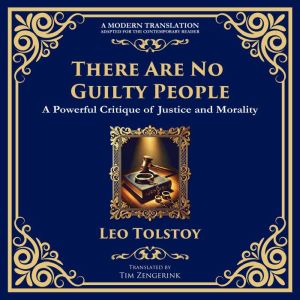
There Are No Guilty People, Leo Tolstoy
List: $14.95 | Sale: $10.47
Club: $7.47

There Are No Guilty People
The Death Penalty, Moral Conscience, and the Illusion of Justice

Author: Leo Tolstoy, Tim Zengerink

Narrator: Zeek Ring

Unabridged: 46 min

Format: Digital Audiobook Download

Published: 09/01/2025


Synopsis

What if the people we punish most severely are the ones we understand least?There Are No Guilty People is Leo Tolstoy’s impassioned outcry against the death penalty, delivered through a mix of storytelling and moral argument. Based on real events and driven by a deep sense of compassion, this work asks the reader to look beyond judgment—and into the heart of what it means to be human.This modern audiobook adaptation preserves the intensity and clarity of Tolstoy’s original message while updating the language for today’s listener.What You’ll Hear in This Modern Translation:• A moving fictional narrative of a condemned man• A passionate and persuasive critique of the justice system• A call to compassion that challenges common ideas of guilt and punishmentIncluded in This Edition:This edition brings new urgency to Tolstoy’s moral message, offering a powerful listening experience that speaks directly to the conscience.Listen now—and reconsider what justice really means.

About Leo Tolstoy

Leo Tolstoy was born in 1828 at Yasnaya Polyana in central Russia and educated privately. He studied Oriental languages and law at the University of Kazan, then led a life of dissipation until 1851, when he went to the Caucasus and joined an artillery regiment. He took part in the Crimean War, and on the basis of this experience wrote The Sevastopol Stories, which confirmed his tenuous reputation as a writer.

After a period in St. Petersburg and abroad, where he studied educational methods for use in his school for peasant children at Yasnaya Polyana, Tolstoy married Sofya Behrs in 1862. The next fifteen years was a period of great happiness: the couple had thirteen children, and Tolstoy managed his estates, continued his educational projects, and wrote War and Peace and Anna Karenina.

A Confession marked a spiritual crisis in Tolstoy's life; he became an extreme moralist, and in a series of pamphlets written after 1880, he expressed his rejection of state and church, indictment of the weaknesses of the flesh, and denunciation of private property. He published his last novel, Resurrection, in 1900.

Tolstoy's teaching earned him many followers at home and abroad, but also much opposition, and in 1901 he was excommunicated by the Russian Orthodox Church. He died in 1910.


Reviews

There are currently no user reviews for this audiobook.