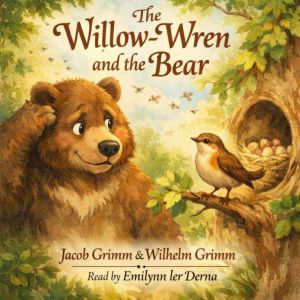
The WillowWren and the Bear, Jacob Grimm
List: $3.67 | Sale: $2.57
Club: $1.83

The Willow-Wren and the Bear

Author: Jacob Grimm, Wilhelm Grimm

Narrator: Emilynn ler Derna

Unabridged: 8 min

Format: Digital Audiobook Download

Published: 01/27/2026


Synopsis

In a quiet forest, a small bird is gravely insulted by a creature many times her size—and refuses to let the offense pass.The Willow-Wren and the Bear is a classic Grimm fairy tale that celebrates wit, unity, and the unexpected power of the small against the mighty. When a boastful bear mocks the humble home and honor of a willow-wren’s family, the tiniest voices of the woods rise in protest. What follows is not a tale of claws and teeth, but of clever planning, cooperation, and poetic justice carried out with charm and humor.As birds, insects, and animals take sides, the story unfolds with playful tension and fairy-tale logic, reminding listeners that respect is not earned by size or strength, but by character. Lightly moral without being heavy-handed, this story delights in the triumph of intelligence over arrogance and fairness over force.Warmly narrated by Emilynn ler Derna, this timeless animal fable is perfect for family listening, bedtime stories, and anyone who enjoys classic fairy tales filled with wit, warmth, and a satisfying sense of justice.

About Jacob Grimm

Jacob Grimm and his brother, Wilhelm, are most famous for their classical collections of folk songs and folktales, especially Children's and Household Tales, which is generally known as Grimm's Fairy Tales. Stories such as "Snow White" and "Sleeping Beauty" have been retold countless times, but the Brothers Grimm first wrote them down. In their collaboration, Wilhelm selected and arranged the stories, while Jacob, who was more interested in language and philology, was responsible for the scholarly work.

Jacob was born in Hanau, Germany, in 1785. His father, who was educated in law and served as a town clerk, died when Jacob was young. His mother, Dorothea, struggled to pay the education of the children. With financial help from Dorothea's sister, Jacob and Wilhelm were sent to Kasel to attend the Lyzeum. Jacob then studied law at Marburg. He worked from 1816 to 1829 as a librarian at Kasel, where his brother served as a secretary. Between 1821 and 1822, the brothers raised extra money by collecting three volumes of folktales. With these publications they wanted to show that Germans shared a similar culture and to advocate the unification process of the small independent kingdoms and principalities.

In 1829, the brothers moved to Gottingen, where Jacob became librarian and Wilhelm became assistant librarian. In 1835, Wilhelm was appointed professor, but they were dismissed two years later for protesting against the abrogation of the Hanover constitution by King Ernest Augustus. In 1840, the brothers accepted an invitation from the King of Prussia, Frederick William IV, to go to Berlin. There, as members of the Royal Academy of Sciences, they lectured at the university. In 1841 they became professors at the University of Berlin, and worked with their most ambitious enterprise, the Deutsches Worterbuch, a large German dictionary. Its first volume appeared in 1854. The work, which totaled sixteen volumes, was finished in the 1960s.

The Grimms made major contributions in many fields, notably in the studies of heroic myth and of ancient religion and law. They worked very close, even after Wilhelm married in 1825. Jacob remained unmarried. Wilhelm died of infection in Berlin on December 16, 1859, and Jacob four years later on September 20, 1863.


Reviews

There are currently no user reviews for this audiobook.