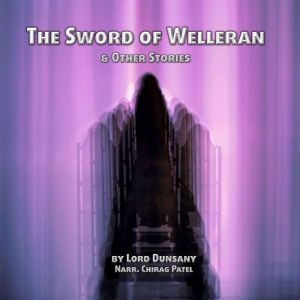
The Sword of Welleran and Other Stori..., Lord Dunsany
List: $6.99 | Sale: $4.90
Club: $3.49

The Sword of Welleran and Other Stories
Strange Tales and Dark Wonders from the Man who Created Modern Fantasy

Author: Lord Dunsany

Series: The Birth Of Fantasy: Lord Dunsany's Seminal Work

Narrator: Chirag Patel

Unabridged: 3 hr 55 min

Format: Digital Audiobook Download

Publisher: Lamplight

Published: 10/10/2024


Synopsis

This was the book that launched a genre. Modern fantasy collections trace their lineage back to Lord Dunsany, and this was his first work that today's readers would recognise in tone and settings.This was the book that launched a genre. Modern fantasy collections trace their lineage back to Lord Dunsany, and this was his first work that today's readers would recognise in tone and settings.

About Lord Dunsany

Lord Dunsany was born in London in 1878, the scion of an Anglo-Irish family that could trace its ancestry to the twelfth century. In 1905 he self-published The Gods of Pegana, and its critical and popular success impelled the publication of numerous other collections of short stories, including A Dreamer's Tales, The Book of Wonder, and The Last Book of Wonder. Dunsany also distinguished himself as a dramatist, and his early plays-collected in Five Plays and Plays of Gods and Men-were successful in Ireland, England, and the United States. Dunsany was seriously injured during the Dublin riots of 1916, and he also saw action in World War I as a member of the Coldstream Guards.

In the 1920s Dunsany began writing novels, among them The King of Elfland's Daughter and The Blessing of Pan. He also wrote many tales of the loquacious clubman Joseph Jorkens, eventually collected in five volumes. His later plays include If, Plays of Near and Far, Seven Modern Comedies, and Plays for Earth and Air. By the 1930s, encouraged by W. B. Yeats and others to write about his native Ireland, he produced The Curse of the Wise Woman, The Story of Mona Sheehy, and other novels. His later tales were gathered in The Man Who Ate the Phoenix and The Little Tales of Smethers, but many works remain uncollected. Lord Dunsany died at Dunsany Castle in County Meath, Ireland, in 1957. He is recognized as a leading figure in the development of modern fantasy literature, influencing such writers as J. R. R. Tolkien, H. P. Lovecraft, and Ursula K. Le Guin.


Reviews

Goodreads review by Tonari on September 22, 2013

Tolkien was a curse for fantasy literature. The professor, speaking the truth, has no fault, but he and the ones who declared the commercial success of the "tolkenian" vision of fantasy (Terry Brooks and Dungeons & Dragons above all) were a curse for this genre. Today, any writer of fantasy must deal......more

Goodreads review by Joseph on April 19, 2014

A splendid collection including some of Dunsany's finer stories (the titular Sword of Welleran, and The Fortress Unvanquishable Save by Sacnoth, amongst others) plus prose poems reminiscent of his earlier work in Time and the Gods and The Gods of Pegana, and the occasional early 20th Century ghost s......more

Goodreads review by Mladen on November 18, 2015

Predivna zbirka priča majstora fantazije. Lord Dansejni je nepravedno zapostavljen na našim prostorima, a kada se spominje, uvek ide samo kao napomena da je Tolkin bio njime inspirisan. Dansejni je mnogo više od zaboravljenog Tolkinovog korena. Njegova maštovitost i jezička raskošnost, poetičan stil......more

Goodreads review by Jay on January 06, 2023

Beautifully written short story collection The Dunsanian prose is next level but that is to be expected from Lord Dunsany! This collection needs to be savoured and appreciated, one reading is not enough; when I have read it a few times I can provide a more detailed review. For now just know that this......more

Goodreads review by Lena on April 22, 2015

Dunsany is a dreamer, and THE SWORD OF WELLERAN AND OTHER STORIES are not just stories but flights of fancy rendered in gorgeous Jacobean language. It is hard to describe the flow of the narrative and control of the language with a few isolated examples, but here is an excerpt that demonstrates the m......more