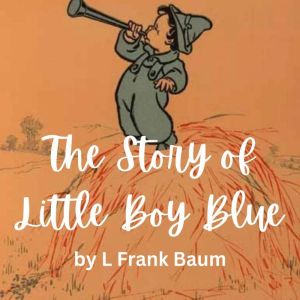
The Story of Little Boy Blue, L. Frank Baum
List: $2.85 | Sale: $2.00
Club: $1.42

The Story of Little Boy Blue
The story behind the nursery rhyme of Little Boy Blue

Author: L. Frank Baum

Narrator: philip chenevert

Unabridged: 17 min

Format: Digital Audiobook Download

Published: 10/21/2023


Synopsis

"Little Boy Blue, come blow your horn,The sheep's in the meadow, the cow's in the corn;Where's the little boy that minds the sheep?He's under the haystack, fast asleep!"So what is this all about? Why is he asleep? Is he just lazy or is there a good reason for this? That wonderful storyteller Baum, of Wizard of Oz fame, tells us the delightful story behind this little rhyme and we all will feel much better knowing that the little boy had excellent reasons to be asleep that morning. Listen and enjoy the whole nifty story. Many of our most loved nursery rhymes are complete tales in themselves, telling their story tersely but completely; there are others which are but bare suggestions, leaving the imagination to weave in the details of the story. Perhaps therein may lie part of their charm, but however that may be the children might like the stories told at greater length, that they may dwell the longer upon their favorite heroes and heroines.

About L. Frank Baum

L. Frank Baum was born in 1856 in Chittenango, New York, to oil magnate Benjamin Ward Baum and Cynthia (Stanton) Baum, a women's rights activist. He was privately tutored at home and spent two years at Peekskill Military Academy.

In 1873, Baum became a reporter for the New York World. Two years later, he founded the New Era weekly in Pennsylvania. He also worked as a poultry farmer with B. W. Baum and Son and edited the Poultry Record and wrote columns for New York Farmer and Dairyman. In New York, Baum acted under the name George Brooks with May Roberts and the Sterling Comedy in plays that he had written. He owned an opera house in 1882-83 and toured with his own repertory company. In 1882 he married Maud Gage; they had four sons.

In 1883, Baum returned to Syracuse to work in the family oil business. His subsequent endeavor was not successful; his South Dakota general store, Baum's Bazaar, failed, and from 1888 to 1890, he ran the Aberdeen Saturday Pioneer. Baum then moved to Chicago and tried various sales positions. In 1897, he founded the National Association of Window Trimmers and edited Show Window from 1897 to 1902.

Baum made his debut as a novelist in 1897 with Mother Goose in Prose, which was based on stories he told to his own children. Its last chapter introduced the farm girl Dorothy. In 1899, Baum published Father Goose: His Book, which quickly became a bestseller. His next work was The Wonderful Wizard of Oz, the story of little Dorothy Gale from Kansas, who is transported by a twister to a magical realm. The book was published at Baum's own expense.

The first of the Oz books was made into a musical in 1901. Since its appearance, the story has been filmed many times. Other novels in the series are The Marvelous Land of Oz, Ozma of Oz, Dorothy and the Wizard of Oz , The Road to Oz, The Emerald City of Oz, The Patchwork Girl of Oz, Tik-Tok of Oz, The Scarecrow of Oz, The Lost Princess of Oz, The Tin Woodman of Oz, The Magic of Oz, Glinda of Oz, and The Visitors from Oz, which was adapted from a comic strip by Baum.

During his career, Baum wrote more than sixty books, some of them for adults, including The Last Egyptian. He also gathered material for works aimed at teenagers during his motoring tours across the country and travels in Europe and Egypt.

Born with a congenitally weak heart, Baum was ill through much of his life. He died on May 6, 1919, in Hollywood, where he lived in a house he called Ozcot.


Reviews

There are currently no user reviews for this audiobook.