The Profits of Religion, Upton Sinclair
List: $7.99 | Sale: $5.60
Club: $3.99

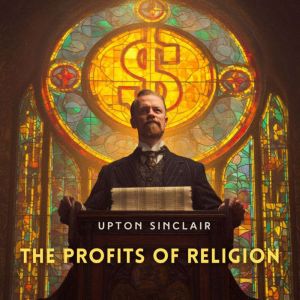
The Profits of Religion
An Essay in Economic Interpretation

Author: Upton Sinclair

Narrator: Eloise Fairfax

Unabridged: 8 hr 18 min

Format: Digital Audiobook Download

Published: 12/24/2025

Categories: Nonfiction, Religion, History


Synopsis

The Profits of Religion: An Essay in Economic Interpretation by Upton Sinclair is a scathing critique of organized religion as an institution entangled with wealth, power, and class oppression. Sinclair argues that religious establishments often serve the interests of the rich, legitimizing social inequality and discouraging reform. Drawing on historical and contemporary examples, he exposes financial corruption, dogma, and the exploitation of faith for profit. From mainstream denominations to new religious movements, he examines how spiritual authority is used to control the working class. A radical work of social criticism, this essay challenges readers to distinguish between genuine morality and institutionalized religion serving economic elites. Part of Sinclair’s “Dead Hand” series, it remains a provocative exploration of faith, capitalism, and justice.

About Upton Sinclair

Upton Sinclair was born in Baltimore, Oregon, on September 20, 1878, and was moved to New York City in 1888. Although his own family were extremely poor, he spent periods of time living with his wealthy grandparents. An intelligent boy, he did well at school, and at age fourteen, he entered New York City College. Soon afterwards, he had his first story published in a national magazine. Over the next few years Sinclair funded his college education by writing stories for newspapers and magazines. By age seventeen, Sinclair was earning enough money to enable him to move into his own apartment while supplying his parents with a regular income.

Sinclair's first novel, Springtime and Harvest, was published in 1901. He followed this with The Journal of Arthur Stirling, Prince Hagen, Manassas, and A Captain of Industry, but they all sold poorly.

In the early 1900s Sinclair became an active socialist, eventually joining with Jack London, Clarence Darrow, and Florence Kelley to form the Intercollegiate Socialist Society. In 1904, the editor of the socialist journal Appeal to Reason commissioned Sinclair to write a novel about immigrant workers in the Chicago meat-packing houses. The owner of the journal provided Sinclair with a $500 advance, and after seven weeks' research, Sinclair wrote The Jungle. Serialized in 1905, the book helped to increase the journal's circulation to 175,000. However, Sinclair had his novel rejected by six publishers. Sinclair decided to publish the book himself, and after advertising his intentions in Appeal to Reason, he got orders for 972 copies. When he told Doubleday of these orders, it decided to publish the book. The Jungle was an immediate success, eventually selling over 150,000 copies all over the world.

Sinclair's next few novels—The Overman, The Metropolis, The Moneychangers, Love's Pilgrimage, and Sylvia—were commercially unsuccessful.

In 1914, Sinclair moved to Croton-on-Hudson, a small town close to New York City where there was a substantial community of radicals. He pleased his socialist friends with his anthology of social protest, The Cry for Justice. Sinclair continued to write political novels, including King Coal, which is based on an industrial dispute, and Boston. He also wrote books about religion (The Profits of Religion), newspapers (The Brass Check), and education (The Goose-Step and The Goslings).

In 1940, World's End launched Sinclair's eleven-volume series on American government. His novel Dragon's Teeth, on the rise of Nazism, won him the Pulitzer Prize. By the time Sinclair died in November 1968, he had published more than ninety books.

Reviews

Goodreads review by Laura on September 11, 2011

Sinclair is a passionate and articulate advocate, and I enjoy his rhetoric on behalf of working people and against social inequality. The main thrust of his argument, however, is that religion, as it now exists, (or more accurately as it then existed) is nothing more than a tool used to keep the opp......more

Goodreads review by Erneilson on October 31, 2017

Socialist and agnostic, Mr. Sinclair has little good to say about religion, ancient or modern. He puts forth his social agenda in strong words and appeals to reason as the ultimate authority. He points out the worst in the churches and accuses all religion and religionists as the principle supporter......more

Goodreads review by Craig on September 04, 2015

"Let us not fail, young comrades; let us not write on the scroll of history that mankind had to go through yet new generations of wars and tumults and enslavements, because the youth of the international revolution could not lift themselves above those ancient personal vices which wrecked the fair h......more

Goodreads review by Mark on January 11, 2015

This book proves to be quite the comprehensive takedown of organized religion. Sinclair chronicles the influence that leaders of organized religion, chiefly the Christian religion, hold over business and government leaders of his time. They strike down unions and those "dangerous" individuals with s......more

Goodreads review by Zenarrow on April 19, 2018

This book would rate higher if the fundamentalists would not pan it based just on their beliefs. Interesting read as you have to remind yourself that it was written in 1918 and before Hitler came into power. Also, Rockefeller, JP Morgan and Carnegie name drops. I had no idea, but it makes sense that......more