List: $3.99
| Sale: $2.80
Club: $1.99
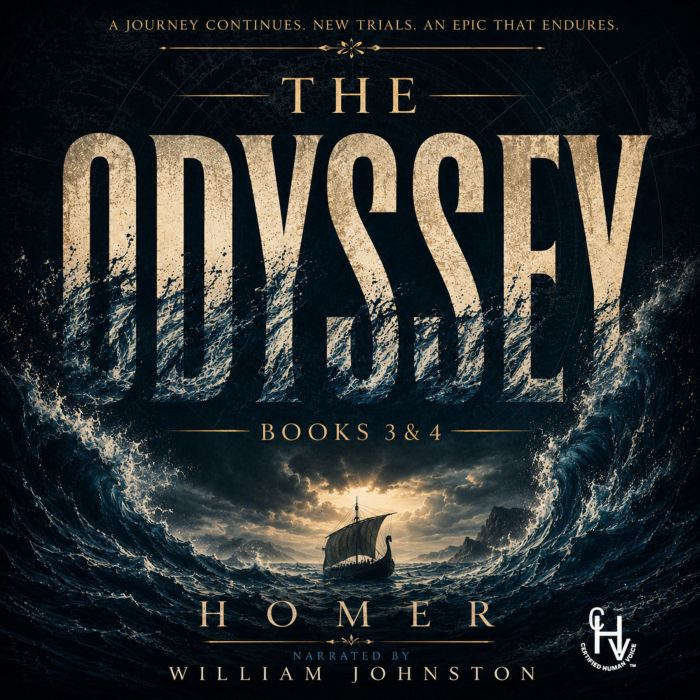
The Odyssey
Books 3 & 4
Author: Homer
Narrator: William Johnston
Unabridged: 1 hr 13 min
Format: Digital Audiobook Download
Publisher: Anthony Pica Productions, LLC
Published: 07/07/2026
Categories: Fiction, Fairy Tales & Legends, Poetry, Ancient & Classical Poetry, Epic Poetry
Synopsis
A son searching for answers. Two legendary kings. The first true hope that Odysseus may still live.
In Books 3 and 4 of Homer’s The Odyssey, Telemachus continues the dangerous search for news of his missing father.
Guided by Athena, he arrives at Pylos and is welcomed by the aged King Nestor, who shares memories of the Trojan War and the troubled homecomings of the Greek commanders. Although Nestor cannot reveal Odysseus’s fate, his stories offer Telemachus valuable lessons about courage, loyalty, and the responsibilities of a son.
The journey then carries Telemachus to Sparta, where King Menelaus and Queen Helen receive him with generous hospitality. Their recollections reveal Odysseus’s remarkable bravery and cunning during the war, while Menelaus recounts his own perilous voyage home and his encounter with Proteus, the mysterious Old Man of the Sea.
At last, Telemachus learns that his father is alive—but trapped far from Ithaca on the island of the nymph Calypso.
Meanwhile, the suitors who have overrun Odysseus’s home discover Telemachus’s mission and begin plotting an ambush that could prevent his return.
Rich with adventure, ancient customs, divine intervention, and stories from the aftermath of Troy, The Odyssey: Books 3 & 4 marks an important stage in Telemachus’s transformation from uncertain youth to courageous heir.
Narrated by William Johnston, this continuation of Homer’s timeless epic brings the kingdoms of Pylos and Sparta vividly to life.
In Books 3 and 4 of Homer’s The Odyssey, Telemachus continues the dangerous search for news of his missing father.
Guided by Athena, he arrives at Pylos and is welcomed by the aged King Nestor, who shares memories of the Trojan War and the troubled homecomings of the Greek commanders. Although Nestor cannot reveal Odysseus’s fate, his stories offer Telemachus valuable lessons about courage, loyalty, and the responsibilities of a son.
The journey then carries Telemachus to Sparta, where King Menelaus and Queen Helen receive him with generous hospitality. Their recollections reveal Odysseus’s remarkable bravery and cunning during the war, while Menelaus recounts his own perilous voyage home and his encounter with Proteus, the mysterious Old Man of the Sea.
At last, Telemachus learns that his father is alive—but trapped far from Ithaca on the island of the nymph Calypso.
Meanwhile, the suitors who have overrun Odysseus’s home discover Telemachus’s mission and begin plotting an ambush that could prevent his return.
Rich with adventure, ancient customs, divine intervention, and stories from the aftermath of Troy, The Odyssey: Books 3 & 4 marks an important stage in Telemachus’s transformation from uncertain youth to courageous heir.
Narrated by William Johnston, this continuation of Homer’s timeless epic brings the kingdoms of Pylos and Sparta vividly to life.