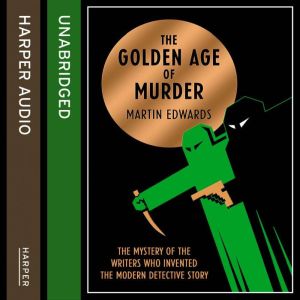
The Golden Age of Murder, Martin Edwards
List: $38.99 | Sale: $27.30
Club: $19.49

The Golden Age of Murder

Author: Martin Edwards

Narrator: Leighton Pugh

Unabridged: 16 hr 31 min

Format: Digital Audiobook Download

Published: 05/07/2015


Synopsis

Winner of the 2016 EDGAR, AGATHA, MACAVITY and H.R.F.KEATING crime writing awards, this real-life detective story investigates how Agatha Christie and colleagues in a mysterious literary club transformed crime fiction. Detective stories of the Twenties and Thirties have long been stereotyped as cosily conventional. Nothing could be further from the truth. The Golden Age of Murder tells for the first time the extraordinary story of British detective fiction between the two World Wars. A gripping real-life detective story, it investigates how Dorothy L. Sayers, Anthony Berkeley, Agatha Christie and their colleagues in the mysterious Detection Club transformed crime fiction. Their work cast new light on unsolved murders whilst hiding clues to their authors’ darkest secrets, and their complex and sometimes bizarre private lives. Crime novelist and current Detection Club President Martin Edwards rewrites the history of crime fiction with unique authority, transforming our understanding of detective stories, and the brilliant but tormented men and women who wrote them.

About Martin Edwards

Martin Edwards has received the CWA Diamond Dagger, the highest honor in British crime writing, given for the sustained excellence of his contribution to the genre. His novels include Mortmain Hall and Gallows Court, which was nominated for two awards including the CWA Historical Dagger. British librarians awarded him the CWA Dagger in the Library in 2018 in recognition of his body of work. His eighth Lake District Mystery is The Crooked Shore and earlier books in the series include The Coffin Trail, shortlisted for the Theakston's prize for best British crime novel.

Martin is a well-known crime fiction critic, and series consultant to the British Library's Crime Classics. His groundbreaking study of the genre between the wars, The Golden Age of Murder, won the Edgar, Agatha, H. R. F. Keating, and Macavity awards. The Story of Classic Crime in 100 Books won the Macavity and was nominated for four other awards, while Howdunit, a masterclass in crime writing by members of the Detection Club, won the H. R. F. Keating prize and was nominated for five other awards.

He has edited over forty anthologies and published diverse nonfiction books, including a study of homicide investigation, Urge to Kill. An expert on crime fiction history, he is archivist of both the Crime Writers' Association and the Detection Club. He was elected eighth president of the Detection Club in 2015, spent two years as chair of the CWA, and posts regularly to his blog, Do You Write Under Your Own Name?


Reviews

Goodreads review by Bev

Fantastic and fascinating book that is an absolute must-have for anyone with interest in the Golden Age of mysteries, crime, and detection. The Golden Age is one of my favorite periods for detective novels and it was an absolute delight to get an inside view of the Detection Club. It is just a real......more


Quotes

‘Few, if any, books about crime fiction have provided so much information and insight so enthusiastically and, for the reader, so enjoyably’ THE TIMES ‘Illuminating and entertaining – provides a new way of looking at old favourites. I admire the way that Martin Edwards weaves the sometimes violent, sometimes unlawful, and always gripping true stories of these writers with the equally wild tales they tell in their books.’ LEN DEIGHTON, author of SS-GB ‘Forensically sharp and exhaustively informed… Crime fiction is driven by death. In this superbly compendious and entertaining book, Edwards ensures that dozens of authorial corpses are gloriously reborn.’ MARK LAWSON, GUARDIAN ‘Edwards knows his business. He understands how to parcel out the clues and red herrings so as to feed the reader enough information to keep a variety of possibilities open, while making sure to prepare for a satisfying solution.’ SEATTLE POST ‘You can learn far more about the social mores of the age in which a mystery is written than you can from more pretentious literature. I mean, if you want to know what it was like to live in England in the 1920s, the so-called Golden Age, you can get a much better steer from mysteries than you can from prize-winning novels.’ P. D. JAMES