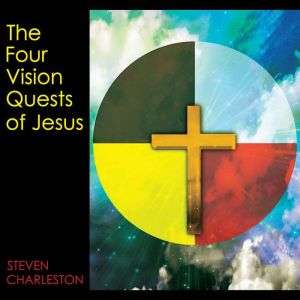
The Four Vision Quests of Jesus, Steven Charleston
List: $34.99 | Sale: $24.50
Club: $17.49

The Four Vision Quests of Jesus

Author: Steven Charleston

Narrator: Kaipo Schwab

Unabridged: 6 hr 58 min

Format: Digital Audiobook Download

Published: 12/20/2024

Includes: Bonus Material Bonus Material Included


Synopsis

A unique look at Christian biblical interpretation and theology from the perspective of Native American tradition. Steven Charleston's The Four Vision Quests of Jesus focuses on four specific experiences of Jesus as portrayed in the synoptic gospels. It examines each story as a “vision quest,” a universal spiritual phenomenon, but one of particular importance within North American indigenous communities. Jesus’ experience in the wilderness is the first quest. It speaks to a foundational Native American value: the need to enter into the “we” rather than the “I.” The Transfiguration is the second quest, describing the Native theology of transcendent spirituality that impacts reality and shapes mission. Gethsemane is the third quest. It embodies the Native tradition of the holy men or women, who find their freedom through discipline and concerns for justice, compassion, and human dignity. Golgotha is the final quest. It represents the Native sacrament of sacrifice (e.g., the Sun Dance). The chapter on Golgotha is a discussion of kinship, balance, and harmony: all primary to Native tradition and integral to Christian thought. This audiobook is masterfully read by Kaipo Schwab, and was produced and published by Echo Point Books & Media, an independent bookseller in Brattleboro, Vermont. Audio engineering by Matthew Kulewicz, MPSE.

About Steven Charleston

Steven Charleston is a leading voice of justice for Indigenous peoples, the environment, and spiritual renewal. A member of the Choctaw Nation, Charleston has appeared on ABC World News Tonight, BBC World News, and other outlets. The author of more than a dozen books on theology and spirituality, including Ladder to the Light, Charleston has served as the Episcopal bishop of Alaska, president and dean of the Episcopal Divinity School, and professor of systematic theology at Luther Seminary. He serves as the theologian in residence at Berkeley Divinity School at Yale University. Charleston lives with his wife, Susan, in Oklahoma.


Reviews

Goodreads review by Spencer on June 30, 2021

This book is a masterpiece in cultural and theological reflection. The author, an indigenous person (Choctaw) as well as a Christian bishop, tells of how in seminary he had a faith crisis reading the book, God is Red, where the author argues Christianity is incompatible with indigenous peoples: its......more

Goodreads review by Ben on April 04, 2021

I've never read anything like this, and, as a Christian, I find this book to be both compelling and challenging to equal degrees. There is much here that will likely cause me to re-read it in the future. There is also a lot here that is going to drive my personal research. I highly recommend this bo......more

Goodreads review by Patrick on October 18, 2015

Deeper things, deeper places led by the Christ of God Being both Lakota and Irish, this offering by Choctaw Brother Steven Charleston resonates with me. If your faith in Christ is sure, this book will expand understanding. If you are not a Christian or even an atheist, you may still find solace and e......more

Goodreads review by Dnicebear on May 28, 2019

I am so happy this book came in to my life, by way of a study group at First Mennonite Church of San Francisco. I was surprised by the many twists that Mr Charleston, an Episcopal priest, gave to familiar scriptures and how he integrated it all with his life and longings and first nations history. I......more

Goodreads review by John Everard Griffith on December 17, 2021

This is a biographical piece sharing Bishop Charleston's path to becoming an Anglican priest. His approach and his resistance to becoming a priest revealed an inner struggle for authenticity and integration of his indigenous faith the Christian faith. Can they be integrated into a wholistic theology......more