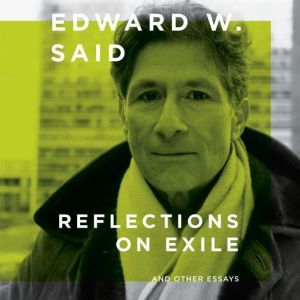
Reflections on Exile, Edward W. Said
List: $35.00 | Sale: $24.50
Club: $17.50

Reflections on Exile
And Other Essays

Author: Edward W. Said

Narrator: Peter Ganim

Unabridged: 33 hr 31 min

Format: Digital Audiobook Download

Published: 10/21/2025


Synopsis

With their powerful blend of political and aesthetic concerns, Edward W. Said's writings have transformed the field of literary studies. This long-awaited collection of literary and cultural essays, the first since Harvard University Press published The World, the Text, and the Critic in 1983, reconfirms what no one can doubt--that Said is the most impressive, consequential, and elegant critic of our time--and offers further evidence of how much the fully engaged critical mind can contribute to the reservoir of value, thought, and action essential to our lives and our culture.

As in the title essay, the widely admired "Reflections on Exile," the fact of his own exile and the fate of the Palestinians have given both form and the force of intimacy to the questions Said has pursued. Taken together, these essays--from the famous to those that will surprise even Said's most assiduous followers--afford rare insight into the formation of a critic and the development of an intellectual vocation. Said's topics are many and diverse, from the movie heroics of Tarzan to the machismo of Ernest Hemingway to the shades of difference that divide Alexandria and Cairo. He offers major reconsiderations of writers and artists such as George Orwell, Giambattista Vico, Georg Lukacs, R. P. Blackmur, E. M. Cioran, Naguib Mahfouz, Herman Melville, Joseph Conrad, Walter Lippman, Samuel Huntington, Antonio Gramsci, and Raymond Williams. Invigorating, edifying, acutely attentive to the vying pressures of personal and historical experience, his book is a source of immeasurable intellectual delight.

Reviews

Goodreads review by Zanna on February 07, 2017

but the work of man is only just beginning and it remains to man to conquer all the violence entrenched in the recesses of his passion And no race possesses the monopoly of beauty of intelligence, of force, and there is a place for all at the rendez-vous of victory -Aime Cesaire Said returns so often to th......more

Goodreads review by Kate on December 15, 2020

Missing Professor Said today as I finish this. I didn't feel much hope when I began this book. The earliest essays are dense literary theory published in the same elite literary journals that make him despair, that make him feel like this whole scholarship thing is a racket, the same niche group buyi......more

Goodreads review by Eliana on May 28, 2014

Es difícil comentar este libro porque resultó complejo, ya sea por la diversidad de temas que trata o por el sinfín de referencias que hay. Said es un gran ensayista, que plantea de una forma que trata de ser sencilla, las dificultades que representa la cultura, la literatura y la identidad en el mu......more

Goodreads review by subhi on May 16, 2020

My biggest criticism of Edward Said’s writing is that his knowledge is too vast and his creative ways of articulating his own critiques of others/constructing an image of the possibilities he’s envisioned was that it was never palatable to the average reader. ‘Reflection on Exile’ does certainly sat......more

Goodreads review by Janine on June 10, 2021

"Exile is strangely compelling to think about but terrible to experience. It is the unhealable rift forced between a human being and a native place, between the self and its true home: its essential sadness can never be surmounted. And while it is true that literature and history contain heroic, rom......more


Quotes

A compilation of 35 years' worth of critical essays from one of the boldest and most articulate cultural theorists alive today. For those who know Said foremost as an outspoken and controversial advocate of Palestine, the breadth of intellectual curiosity and erudition manifest in these collected works will come as a pleasant surprise. Not until halfway through the anthology is there any mention of Palestine, and even in those essays that deal with his homeland, the author uses his unparalleled knowledge of the subject to illustrate larger points about anthropology, human rights, or nationalism...Said demonstrates that he is indeed a modern teacher and critic of the highest order...And yet, even the least political of his essays further his goal: to deprive us of our complacency by reminding us again and again that all knowledge is mediated by power, and no one is immune to its balance...Fascinating.—Kirkus Reviews

Said views all of culture through the lens of 'historical experience,' emphasizing how feminism, ethnic and minority experience, and nationalism have broken tradition's grip on literature...Given his keenly penetrating and original cast of mind, it is not surprising that Said's personal pantheon of heroes includes those who blur the line between criticism and creation, among them Foucault, Nietzsche, Gramsci, Barthes, Adorno, and John Berger, not to mention pianist Glenn Gould, composer and conductor Pierre Boulez and filmmaker Gillo Pontecorvo...This wide-ranging and brilliant collection is a fitting tribute to one of our leading scholars, who has changed the way we look at Western culture.—Publishers Weekly

For more than a third of a century, Columbia University professor Said has written insightfully about literature, culture, and the Middle East. This volume gathers nearly 50 essays, most on literary subjects, although Said also addresses philosophy and history, the arts and current events.—Mary Carroll, Booklist

As these essays make clear, Said is engaged on a quest to connect what people want with the way they must live, even if that means discovering that the two ways are sometimes irreconcilable. His is a passionate strategy...[The essays are] little lamps that light up the great tangled forest of literature and philosophy.—David Kirby, San Francisco Chronicle

The collection, much more than the sum of its parts, is the portrait of an exemplary intellectual life, in which rigor and clarity join with courage and commitment, and both with a rare kind of unswerving joy at the complex face of reality...This is surely a major work, among the most provocative and cogent accounts of culture and the humanities that America has produced in recent years. Said's essays have a remarkable unity of position, given their temporal range. They contain no major swervings, no apologies--only a gradual maturing of his best insights, as they are applied to changing circumstances in politics and the academy...If there is a change in Said's thinking, it is perhaps a subtle shift toward greater hopefulness.—Martha C. Nussbaum, New York Times Book Review

Said's work has been transformative...[Reflections on Exile is] indispensable for all college and university libraries.—K. Tölölyan, Choice

Edward Said may be the world's most famous English professor, and its most famous Palestinian after Yasir Arafat...Said turned 65 last year, having survived a life-threatening disease of the blood diagnosed nearly a decade ago. It is not surprising, therefore, that his recent publications have taken a retrospective turn...His latest book, Reflections on Exile--a monumental collection of essays spanning his 35 year career at Columbia University--is another result of his effort to impose thematic unity on his wide-ranging intellectual life.—Mark Walhout, Books & Culture

These essays...form a remarkably cohesive whole and attest to the rigor and passionate seriousness of a lifetime of scholarship.—Kate Blakinger, Boston Review

Said's agile mind and learned voice are irreplaceable: no one combined his background and activism as a Palestinian with his magisterial criticism of literature, music, culture, and politics throughout a world increasingly divided into fundamentalist camps…He was fully engaged with every part of the world, a goal of every educated person, and one that I wish for everyone's summer reading.—Henry St. Maurice, Phi Delta Kappan

The collection will serve as an ideal primer in the evolution of a critical position that established [Said's] international reputation--and gained him some fierce opponents--as a leading intellectual voice in the humanities…One of the many pleasures of this volume lies in Said's command of the personal essay…This collection contains a variety of essays that equally display his aesthetic refinement, his comparative perspective, his interdisciplinary spirit, and his ideological conviction.—Philip Mosley, Comparative Literature Studies