List: $6.99
| Sale: $4.90
Club: $3.49
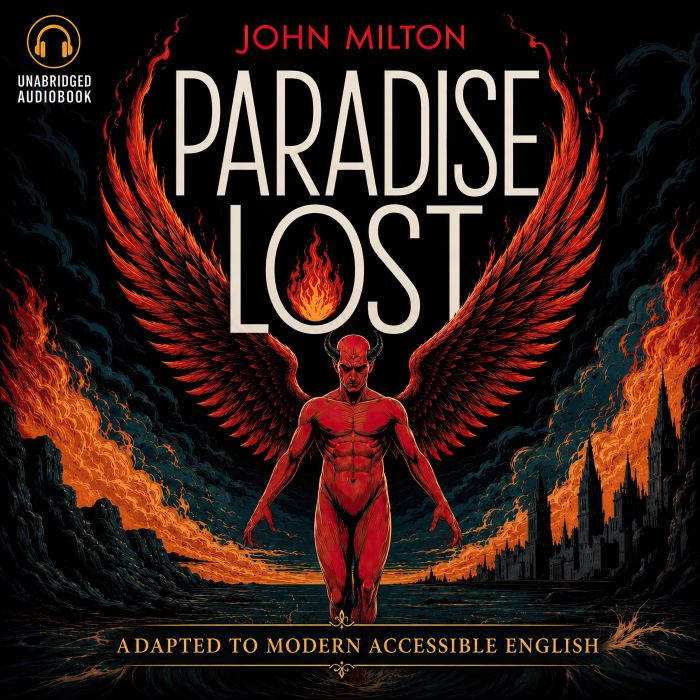
Paradise Lost
Adapted to Modern Accessible English
Author: John Milton
Narrator: AI Voice Audrey Ellsworth
Unabridged: 10 hr 30 min
Format: Digital Audiobook Download
Publisher: Independently Published
Published: 07/08/2026
Categories: Fiction, Poetry, Ancient & Classical Poetry, Epic Poetry
Synopsis
This audiobook is narrated by an AI Voice. In 1667, John Milton — blind, aging, politically disgraced after the collapse of England's republican revolution — completed Paradise Lost. He had spent years defending regicide and press freedom; when the Restoration returned monarchy, his political project ended catastrophically. He turned to poetry and produced an epic explaining humanity's first disobedience: why an omnipotent, benevolent God would permit the Fall.
The poem creates a cosmos of extraordinary imaginative power: Hell as "darkness visible," Heaven with its angelic hierarchies, Eden rendered with sensuous detail. Satan possesses psychological depth that makes him literature's most compelling villain — the fallen angel who declares "Better to reign in Hell, than serve in Heaven." His magnificent defiance in the early books systematically degrades until by Book IX he is a serpent crawling on his belly.
The central question is whether Satan is the hero. The Romantic poets thought so — Blake claimed Milton was "of the Devil's party without knowing it." Yet careful reading reveals a deliberate strategy: Satan's soliloquies expose not heroic defiance but psychological torture, the inability to repent, envy driving him to destroy what he cannot enjoy.
This presents modernization rather than translation. Milton's rhythms, his syntactic architecture, his learned vocabulary cannot be simplified without fundamental transformation. What modernization offers is access to narrative and themes for readers who find seventeenth-century English insurmountable — an introduction, not a substitute for the original.
The poem creates a cosmos of extraordinary imaginative power: Hell as "darkness visible," Heaven with its angelic hierarchies, Eden rendered with sensuous detail. Satan possesses psychological depth that makes him literature's most compelling villain — the fallen angel who declares "Better to reign in Hell, than serve in Heaven." His magnificent defiance in the early books systematically degrades until by Book IX he is a serpent crawling on his belly.
The central question is whether Satan is the hero. The Romantic poets thought so — Blake claimed Milton was "of the Devil's party without knowing it." Yet careful reading reveals a deliberate strategy: Satan's soliloquies expose not heroic defiance but psychological torture, the inability to repent, envy driving him to destroy what he cannot enjoy.
This presents modernization rather than translation. Milton's rhythms, his syntactic architecture, his learned vocabulary cannot be simplified without fundamental transformation. What modernization offers is access to narrative and themes for readers who find seventeenth-century English insurmountable — an introduction, not a substitute for the original.