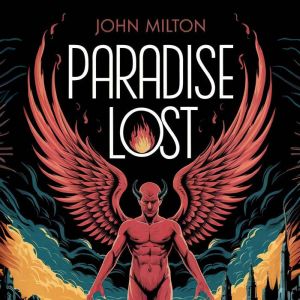
Paradise Lost, John Milton
List: $9.99 | Sale: $7.00
Club: $4.99

Paradise Lost
A New Translation in Modern Accessible English

Author: John Milton

Narrator: Audrey Ellsworth

Unabridged: 11 hr 40 min

Format: Digital Audiobook Download

Published: 03/15/2026


Synopsis

In 1667, John Milton—blind, aging, politically disgraced after England's republican collapse—completed Paradise Lost. Years defending regicide and press freedom ended catastrophically with the Restoration. He turned to poetry to explore humanity's first disobedience: why an omnipotent, benevolent God would permit the Fall.The poem creates an extraordinary cosmos: Hell as "darkness visible," Heaven's angelic hierarchies, Eden rendered with sensuous detail. Satan is literature's most compelling villain—a fallen angel who declares "Better to reign in Hell, than serve in Heaven." His magnificent defiance degrades until Book IX, where he's reduced to a crawling serpent.Is Satan the hero? Romantic poets thought so—Blake claimed Milton was "of the Devil's party without knowing it." Yet Satan's soliloquies reveal not heroic defiance but psychological torture, envy driving him to destroy what he cannot enjoy.The Fall is a psychological masterpiece: Satan tempting Eve through flattery, her extended deliberation, Adam choosing disobedience rather than imagine existence without her. Shame, guilt, expulsion follow—yet the poem concludes with qualified hope, "Providence their guide."Milton's blank verse—unrhymed iambic pentameter with elaborate Latinate syntax—was revolutionary, single sentences extending for dozens of lines, enacting meaning through form.A Note on This Edition: This is modernization, not translation—Milton's rhythms and syntactic architecture cannot be simplified without fundamental transformation. Anyone serious about Milton should encounter the original; meaning and form are inseparable here. This edition is a substitute for, not equivalent to, the poem itself, which deserves the effort it requires.

About John Milton

John Milton was born in London, England, on December 9, 1608, into a middle-class family. He was educated at St. Paul's School, then at Christ's College, Cambridge, where he began to write poetry in Latin, Italian, and English, while preparing to enter the clergy.

After university, however, he abandoned his plans to join the priesthood and spent the next six years in his father's country home in Buckinghamshire studying and preparing for a career as a poet. He gained proficiency in Latin, Greek, Hebrew, French, Spanish, and Italian, and obtained a familiarity with Old English and Dutch as well.

In 1642, Milton returned from a trip into the countryside with a sixteen-year-old bride, Mary Powell. Even though they were estranged for most of their marriage, she bore him three daughters and a son before her death in 1652. Milton later married twice more.

During the English Civil War, Milton championed the cause of the Puritans and Oliver Cromwell, and wrote a series of pamphlets advocating radical political topics, including the morality of divorce, the freedom of the press, populism, and sanctioned regicide. Milton served as secretary for foreign languages in Cromwell's government, composing official statements defending the Commonwealth. During this time, Milton steadily lost his eyesight and was completely blind by 1651. He continued his duties, however, with the aid of Andrew Marvell and other assistants.

After the Restoration of Charles II to the throne in 1660, Milton was arrested as a defender of the Commonwealth, fined, and soon released. He lived the rest of his life in seclusion in the country, completing the blank-verse epic poem Paradise Lost, which is widely regarded as his masterpiece and one of the greatest epic poems in world literature. Milton also produced a sequel, Paradise Regained, and the tragedy Samson Agonistes. Milton oversaw the printing of a second edition of Paradise Lost in 1674, which included an explanation of "why the poem rhymes not," clarifying his use of blank verse, along with introductory notes by Marvell. He died shortly afterwards, on November 8, 1674, in Buckinghamshire, England.


Reviews

There are currently no user reviews for this audiobook.