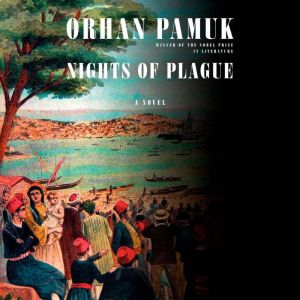
Nights of Plague, Orhan Pamuk
List: $32.50 | Sale: $22.75
Club: $16.25

Nights of Plague
A novel

Author: Orhan Pamuk, Ekin Oklap

Narrator: Amira Ghazalla

Unabridged: 29 hr 8 min

Format: Digital Audiobook Download

Published: 10/04/2022


Synopsis

From the the winner of the Nobel Prize in Literature: Part detective story, part historical epic—a bold and brilliant novel that imagines a plague ravaging a fictional island in the Ottoman Empire.

It is April 1900, in the Levant, on the imaginary island of Mingheria—the twenty-ninth state of the Ottoman Empire—located in the eastern Mediterranean between Crete and Cyprus. Half the population is Muslim, the other half are Orthodox Greeks, and tension is high between the two. When a plague arrives—brought either by Muslim pilgrims returning from the Mecca or by merchant vessels coming from Alexandria—the island revolts. 

To stop the epidemic, the Ottoman sultan Abdul Hamid II sends his most accomplished quarantine expert to the island—an Orthodox Christian. Some of the Muslims, including followers of a popular religious sect and its leader Sheikh Hamdullah, refuse to take precautions or respect the quarantine. And then a murder occurs. 

As the plague continues its rapid spread, the Sultan sends a second doctor to the island, this time a Muslim, and strict quarantine measures are declared. But the incompetence of the island’s governor and local administration and the people’s refusal to respect the bans doom the quarantine to failure, and the death count continues to rise. Faced with the danger that the plague might spread to the West and to Istanbul, the Sultan bows to international pressure and allows foreign and Ottoman warships to blockade the island. Now the people of Mingheria are on their own, and they must find a way to defeat the plague themselves. 

Steeped in history and rife with suspense, Nights of Plague is an epic story set more than one hundred years ago, with themes that feel remarkably contemporary.

About The Author

ORHAN PAMUK won the Nobel Prize for Literature in 2006. His novel My Name Is Red won the 2003 International IMPAC Dublin Literary Award. His work has been translated into more than sixty languages. He lives in Istanbul. Translated by Ekin Oklap. 


Reviews

Goodreads review by Cenk on March 30, 2021

Orhan Pamuk’un Nobel sonrası en iyi romanı yorumlarına katılıyorum. Ancak Kara Kitap, Benim Adım Kırmızı, Kar gibi zirve romanlarından fersah fersah uzakta olduğu şerhini de düşmem lazım. Son romanları gibi çok hikaye odaklı, kör göze parmak ve bize değil yabancılara. Kara Kitap, Kar, Benim Adım Kırm......more

Goodreads review by William2 on February 10, 2024

1. The book doesn't sing. It's not a bad book. It's just not an excellent book. It reads like one of Anthony Trollop's novels, say, The Duke's Children. Solid narrative but nothing particularly inventive. Straightforward. Quasi-Victorian. Strangely, too, in the passage where Princess Pakize consider......more

Goodreads review by Biron on April 24, 2021

Yaşayan en büyük yazar Orhan Pamuk'un beni çok şaşırtan, üstüne uzun uzun düşünme ihtiyacı yaratan romanı Veba Geceleri ile ilgili, bitirdikten günler sonra bir şeyler yazabilmeye cesaret ediyorum. Yıllar süren bekleyişten sonra, hem bu bekleyişin etkisiyle romana doğru yaklaşıp yaklaşmadığımı gözde......more

Goodreads review by Hakan on April 30, 2021

farklı bir roman, farklı bir orhan pamuk romanı. üzerinde düşünmeyi hak ediyor her şeyden önce. burada hem "akıcı değil-kahramanlar derin değil-romanın içine giremedim" tarzındaki olumsuz yorumlarda hem de "en gerçek orhan pamuk okuruyum, bir kara kirap değil" türündeki eleştirilerde ve hatta "yılla......more

Goodreads review by Zeren on April 02, 2021

Benim için baya baya unutulmaz olabilecek bir romanın güdük bırakılmış olması konusunda biraz üzgünüm. Ama hemen şunu da söylemezsem olmaz, buna rağmen etkileyici bir serüvendi. Çünkü Orhan Pamuk söz konusu olduğunda hep olduğu gibi çok çalışılmış, çok düşünülmüş bir roman. Etkilenmemek zor. Benim e......more


Quotes

A New Yorker Best Book of the Year

"[Nights of Plague] effortlessly generates a set of resonances that the novelist could hardly have predicted when he started the book....Pamuk's lovingly obsessive creation of the invented Mediterranean island of Mingheria, a world so detailed, so magically full, so introverted and personal in emphasis, that it shimmers like a memory palace, as if Pamuk were conjuring up a lost city of his youth, Istanbul’s exilic, more perfect alter ego. The effect is daringly vertiginous, at once floatingly postmodern and solidly realistic, something like Italo Calvino’s “Invisible Cities” crossed with the nostalgic re-creations of Joyce’s lost Dublin, or Joseph Roth’s vanished Austro-Hungarian Empire...Mingheria, as Pamuk conceives it, is an impossible Eden...a fantastical, fantastically beautiful place...the book is engrossing and easy to read. The result is strangely paradoxical: a big but swift novel, a novel about pain and death that is fundamentally light and buoyant." —James Wood, The New Yorker

Nights of Plague, Pamuk’s 11th — and longest — novel, is a real book about an imaginary place, Mingheria, an island in the eastern Mediterranean between Crete and Cyprus...Like William Faulkner, who provided a map of his fictional Yoknapatawpha County, Pamuk places a map of Mingheria (capital: Arkaz) at the beginning of his book...Like works by Albert Camus, Daniel Defoe and Alessandro Manzoni  (whose “The Betrothed” provides an epigraph), this is a plague narrative, a record of Mingheria’s deadly yearlong ordeal...But “Nights of Plague” is also an origin story, an account of how a proud island nation achieved its sovereignty... A story that should resonate loudly with the current pandemic. . . . Thrilling." —Steven G. Kellman, Los Angeles Times

"As it pivots between saga and satire, mystery and pseudo-history...[Pamuk] shows nous, charm and cunning as he keeps his bulky cargo afloat and on the move. If this generous hybrid of epidemic soap opera and novel of ideas has becalmed patches, it stirs the senses and flexes the mind. You will be sad to leave lavishly imagined Mingheria, where ‘a view of the sea and a trace of its scent’ can always ‘make life seem worth living again’." Boyd Tonkin, The Spectator
 
"One of the most interesting books I’ve read this year...[Pamuk] flout[s] the normal rules of storytelling...And yet none of these infringements of literary convention seems to matter much when set against the exuberance of Pamuk’s invention...a compendium of literary experiments, ludic, audacious, exasperating and entertaining." —Lucy Hughes-Hallett, The Guardian

"Deftly blending rich realism and wry social commentary, Turkish Nobel laureate Pamuk...delivers an invented history that leverages the all-too-familiar experience of a deadly pandemic to return to one of his cherished topics: Ottoman bureaucratic and social reform...Pamuk is always a must-read, and the potency and timeliness of this novel will stir even more interest." —Brendan Driscoll, Booklist (starred review)

"Consistently captivating ... the cracking narrative will keep readers in for the long haul." Publishers Weekly