List: $3.99
| Sale: $2.80
Club: $1.99
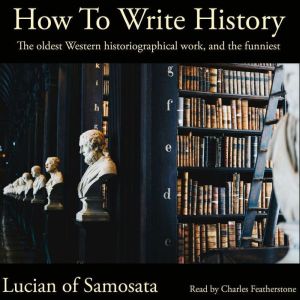
How to Write History
The oldest Western historiographical work, and the funniest
Author: Lucian of Samosata
Narrator: Charles Featherstone
Unabridged: 50 min
Format: Digital Audiobook Download
Publisher: Brimir & Blainn
Published: 08/03/2026
Categories: Nonfiction, History, Ancient History, European History, Study Aids
Synopsis
The origin of the phrase “call a spade a spade.”
Πῶς δεῖ ἱστορίαν συγγράφειν was written in the mid‑160s AD, and is the the most complete surviving ancient treatise on historiographical method.
Prompted by the deluge of amateur accounts celebrating Rome’s recent Parthian War under Lucius Verus, Lucian rips into the mania for writing history that has overtaken his culture, and rips into the constant errors that amateur and professional historians make in hteir search for glory.
Among the worst offenders, Lucian singles out the physician Callimorphus, who swamps his narrative with a lengthy medical description of the plague, substituting technical display for historical proportion. An anonymous author is ridiculed for prefacing his work with the creation of the universe, only to dispatch the Parthian campaign itself in a few meagre lines, when a historian’s subject should dictate the structure and flow of the work. As Lucian says, “brevity is always desirable.” The historian’s is to work with the materials they’ve got, not to invent new ones or focus on the minor details.
Other writers get called out for transforming the Roman general into a Homeric hero, opting for epic poetry and flattery over raw facts. You’re doing it wrong when you write for praise, the favour of patrons, or the immediate gratification of a popular audience. Sacrificing truth to rhetoric, and utility to ornament, is the heart of being terrible at writing a meaningful history.
Lucian’s ideal historian is Thucydides, with his commitment to truth, impartiality, and understanding that his job is “to say what happened”. Xenophon also gets credit for clarity, selection, and simple pleasure. The true historian writes a “possession for all time”, keeping the narrative useful rather than entertaining.
Lucian’s insight shaped Western historical thinking for nearly two millennia, and rings as true today as when it was written.
Πῶς δεῖ ἱστορίαν συγγράφειν was written in the mid‑160s AD, and is the the most complete surviving ancient treatise on historiographical method.
Prompted by the deluge of amateur accounts celebrating Rome’s recent Parthian War under Lucius Verus, Lucian rips into the mania for writing history that has overtaken his culture, and rips into the constant errors that amateur and professional historians make in hteir search for glory.
Among the worst offenders, Lucian singles out the physician Callimorphus, who swamps his narrative with a lengthy medical description of the plague, substituting technical display for historical proportion. An anonymous author is ridiculed for prefacing his work with the creation of the universe, only to dispatch the Parthian campaign itself in a few meagre lines, when a historian’s subject should dictate the structure and flow of the work. As Lucian says, “brevity is always desirable.” The historian’s is to work with the materials they’ve got, not to invent new ones or focus on the minor details.
Other writers get called out for transforming the Roman general into a Homeric hero, opting for epic poetry and flattery over raw facts. You’re doing it wrong when you write for praise, the favour of patrons, or the immediate gratification of a popular audience. Sacrificing truth to rhetoric, and utility to ornament, is the heart of being terrible at writing a meaningful history.
Lucian’s ideal historian is Thucydides, with his commitment to truth, impartiality, and understanding that his job is “to say what happened”. Xenophon also gets credit for clarity, selection, and simple pleasure. The true historian writes a “possession for all time”, keeping the narrative useful rather than entertaining.
Lucian’s insight shaped Western historical thinking for nearly two millennia, and rings as true today as when it was written.