List: $14.99
| Sale: $10.50
Club: $7.49
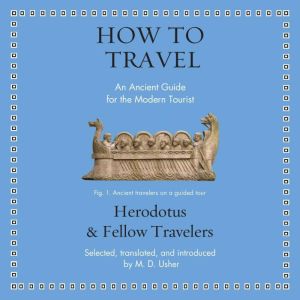
How to Travel
An Ancient Guide for the Modern Tourist
Author: Herodotus, M. D. Usher
Narrator: Leon Nixon
Unabridged: 2 hr 32 min
Format: Digital Audiobook Download
Publisher: Spotify Audiobooks
Published: 05/05/2026
Categories: Nonfiction, Self-help, Personal Growth, Travel, Philosophy, History & Surveys
Synopsis
A transporting anthology of ancient Greek and Roman travel writings that capture the thrill of exploration and discovery—from Europe to the Holy Land and Egypt to India
At long last, a travel guide to the ancient world for the modern tourist—written by the ancients themselves. How to Travel gathers classic texts from Greek and Roman writers to explore what today’s readers can learn from ancient encounters with unfamiliar peoples, places, and customs.
The Greek historian Herodotus (ca. 484–425 BCE) is one of the most famous travelers of antiquity. His Histories, which chronicle his and others’ encounters with foreign peoples and places, have fascinated readers for millennia, and have much to teach about the secrets of good travel. In How to Travel, Herodotus and Tacitus take us on tours of Central Asia, Egypt, and Germania, while pilgrims like Pausanias and the Christian nun Egeria guide us through Greece and the Holy Land. Readers are whisked away to India to experience the ways of forest-dwelling sages and to the far reaches of Africa. And as if Earth weren’t enough, the satirist Lucian takes us to the Moon. But this whirlwind tour of antiquity is more than a pleasure cruise. Seneca cautions travelers that, go as far as we may, we can never escape ourselves. Gratitude, Egeria says, is the traveler’s proper response for the privilege. And Homer reminds us that, ultimately, there’s no place like home.
Featuring vivid new translations, an inviting introduction, and the original Greek and Latin texts on facing pages, How to Travel captures the thrill of exploration and discovery—and how new experiences, fresh vistas, and foreign cultures can change the traveler.
At long last, a travel guide to the ancient world for the modern tourist—written by the ancients themselves. How to Travel gathers classic texts from Greek and Roman writers to explore what today’s readers can learn from ancient encounters with unfamiliar peoples, places, and customs.
The Greek historian Herodotus (ca. 484–425 BCE) is one of the most famous travelers of antiquity. His Histories, which chronicle his and others’ encounters with foreign peoples and places, have fascinated readers for millennia, and have much to teach about the secrets of good travel. In How to Travel, Herodotus and Tacitus take us on tours of Central Asia, Egypt, and Germania, while pilgrims like Pausanias and the Christian nun Egeria guide us through Greece and the Holy Land. Readers are whisked away to India to experience the ways of forest-dwelling sages and to the far reaches of Africa. And as if Earth weren’t enough, the satirist Lucian takes us to the Moon. But this whirlwind tour of antiquity is more than a pleasure cruise. Seneca cautions travelers that, go as far as we may, we can never escape ourselves. Gratitude, Egeria says, is the traveler’s proper response for the privilege. And Homer reminds us that, ultimately, there’s no place like home.
Featuring vivid new translations, an inviting introduction, and the original Greek and Latin texts on facing pages, How to Travel captures the thrill of exploration and discovery—and how new experiences, fresh vistas, and foreign cultures can change the traveler.