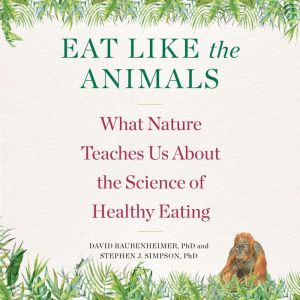
Eat Like The Animals, David Raubenheimer
List: $25.99 | Sale: $18.20
Club: $12.99

Eat Like The Animals
What Nature Teaches Us About the Science of Healthy Eating

Author: David Raubenheimer, Stephen Simpson

Narrator: Paul Panting

Unabridged: 7 hr 36 min

Format: Digital Audiobook Download

Publisher: Harvest

Published: 04/07/2020


Synopsis

A New Scientist Best Book of 2020

Our evolutionary ancestors once possessed the ability to intuit what food their bodies needed, in what proportions, and ate the right things in the proper amounts—perfect nutritional harmony. From wild baboons to gooey slime molds, most every living organism instinctually knows how to balance their diets, except modern-day humans. When and why did we lose this ability, and how can we get it back?David Raubenheimer and Stephen Simpson reveal the answers to these questions in a gripping tale of evolutionary biology and nutritional science, based upon years of groundbreaking research. Their colorful scientific journey takes readers across the globe, from the foothills of Cape Town, to the deserts of Arizona, to a state-of-the-art research center in Sydney. Readers will encounter locusts, mice and even gorillas along the way as the scientists test their hypotheses on various members of the animal kingdom.This epic scientific adventure culminates in a unifying theory of nutrition that has profound implications for our current epidemic of metabolic diseases and obesity. Raubenheimer and Simpson ultimately offer useful advice to understand the unwanted side effects of fad diets, gain control over one’s food environment, and see that delicious and healthy are integral parts of proper eating.

About David Raubenheimer

DAVID RAUBENHEIMER PhD, is the Leonard P. Ullman Professor of Nutritional Ecology in the School of Life and Environmental Sciences, and Nutrition Theme Leader in the Charles Perkins Centre, at the University of Sydney. He lectures extensively at universities and conferences around the world. He co-wrote The Nature of Nutrition: A Unifying Framework from Animal Adaptation to Human Obesity with Stephen J. Simpson. He lives in Sydney, Australia.  

About Stephen Simpson

STEPHEN J. SIMPSON, PhD, is Academic Director of the Charles Perkins Centre and Professor in the School of Life and Environmental Sciences at the University of Sydney. He is the recipient of the Royal Entomological Society’s Wigglesworth Medal, The Eureka Prize, a Fellow of the Royal Society of London and a Companion of the Order of Australia. He has also been prominent in the media and television both in the UK and Australia, having appeared on National Geographic, Animal Planet and History Channels in the UK and also as the presenter of a four-part documentary series for ABC TV, Great Southern Land. He lives in Sydney, Australia.  


Reviews

Goodreads review by Kevin on July 14, 2021

Good read, >Alligned what I already thought and my own basic understanding of my health. >Reinforced the message around eating healthy Conclusion : 1. Estimate your protein intake : per the book protein is one of the key levers which are used by our body to regulate weight, health, aging.  2. Avoid ultr......more

Goodreads review by E J on May 01, 2022

Fascinating in the beginning, but lapsed into sort of romantic, fetishising “paradise” of “tribal” people type yarns, before talking about how bad industrial food is. I think it’s clear they’ve wandered out of their area of expertise here as the book shifts from laying out methodology, experiments,......more

Goodreads review by Mehtap on September 03, 2020

Die Ernährungswissenschaflter Raubenheimer und Simpson haben mit Hilfe von Wanderheuschrecken herausgefunden, welche Rückschlüsse wir von dem Essverhalten auf den Menschen ziehen können. Tiere können genau entscheiden wie viel Proteine und Nährstoffe sie brauchen und können das Essen und ihren Nährst......more

Goodreads review by Elinor on June 05, 2020

I enjoyed this book, and found it fascinating to read about the many and varied research experiments and observation of creatures in the wild that led the authors to their conclusions. Their thesis is that most creatures, including humans, eat to reach a certain level of protein in their diet, regard......more